
Juvenile Court’s Disputes With Union Must Go to Arbitration
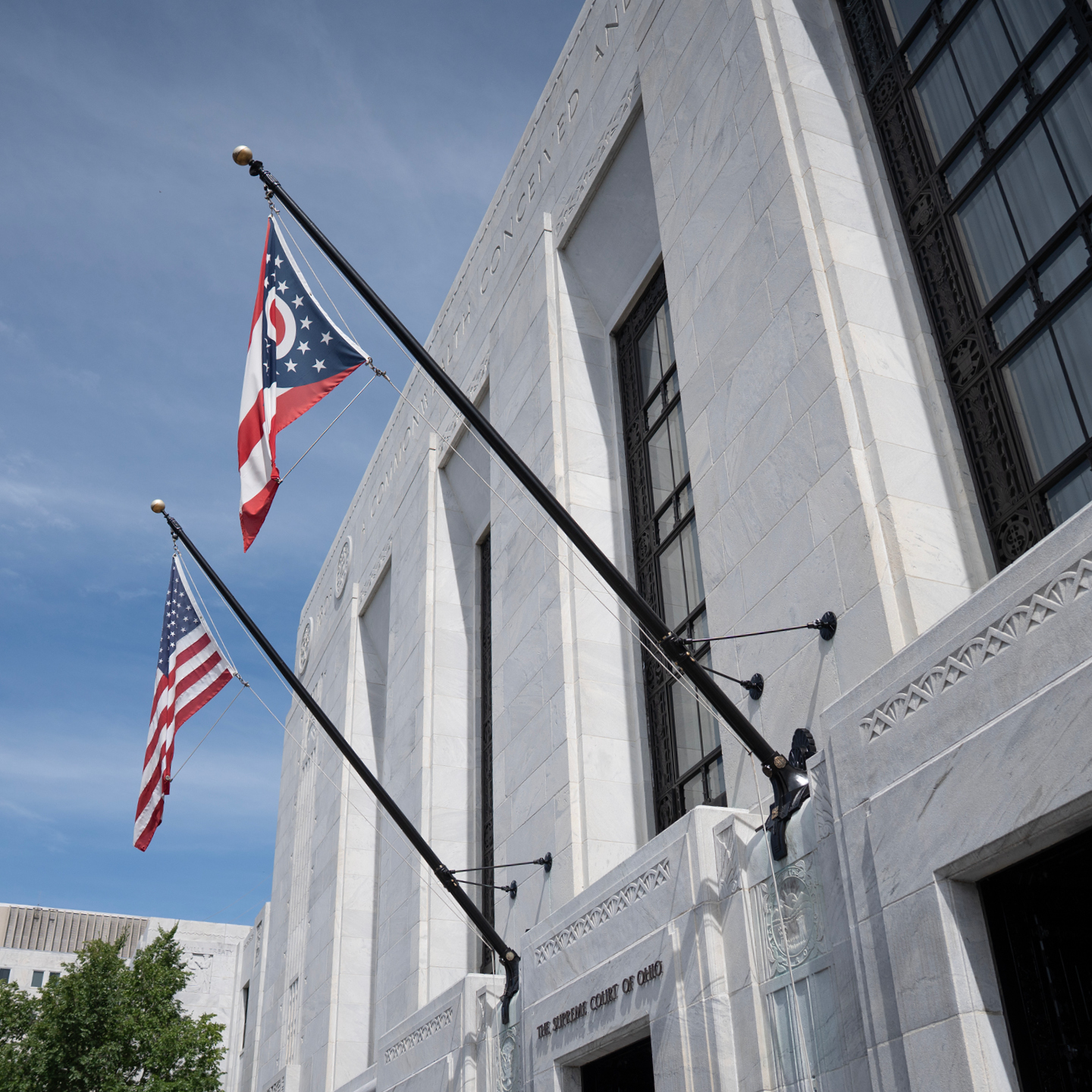
Disputes between the Cuyahoga County Common Pleas Court’s Juvenile Division and its union employees must go to arbitration.
Disputes regarding the two collective bargaining agreements between the Cuyahoga County Common Pleas Court’s Juvenile Division and its union employees must go to arbitration, the Supreme Court of Ohio ruled today.
In a unanimous opinion, the Supreme Court affirmed the Eighth District Court of Appeals decision that directed that the legal matter between the juvenile court and Laborers’ International Union of North America, Local 860, must go to arbitration rather than be settled in court.
Juvenile Court Administrative Judge Thomas O’Malley initiated lawsuits in 2020 to declare that Local 860’s two collective bargaining agreements with the court ended in December 2019. The union counterclaimed, alleging that the juvenile court had breached the contracts and it moved to compel arbitration under the terms of the contracts.
Writing for the Supreme Court, Justice Patrick F. Fischer explained that each contract contained a provision stating that the parties agreed to arbitrate disputes between the court and the union regarding the interpretation, application, or compliance with the contract's express provisions. The juvenile court’s claims that the contracts were terminated or could not be extended beyond 2019 are questions of interpretation and the application of the terms of the contract, he wrote.
“Here, the arbitration clauses cover the disputes in question, and the trial court therefore erred in failing to order the parties to proceed to arbitration,” he stated.
Union Challenges Contract Termination
Local 860 entered into two collective bargaining agreements with the juvenile court. One contract covered the employees who work at the Cuyahoga County Juvenile Detention Center, and the other covered employees who work for the juvenile court in other capacities.
The contracts are generally the same and contain three clauses that are in dispute: a duration clause, an evergreen clause, and an arbitration clause.
The duration clause stated the union contracts would remain in full force and effect until Dec. 31, 2019.
The evergreen clause allowed the duration of the contract to be extended. The clause indicated the contracts would remain in effect until one of three events occurred: a new collective bargaining agreement was negotiated between the parties; the union no longer agreed to represent the employees; or the employees elected to decertify the union.
Each contract contained an arbitration clause requiring the parties to arbitrate any grievance they were unable to resolve under the procedures set out in the contract.
When negotiations for a new contract failed, the juvenile court filed two lawsuits in the general division of the common pleas court. It sought a declaratory judgment, asking the common pleas court to rule that the contracts expired in 2019 under the duration clause. In the alternative, the juvenile court asked the court to rule that the contracts were void ab initio because the evergreen clauses invalidated the contracts.
The juvenile court informed its union employees that it had filed the lawsuits, and the collective bargaining agreements no longer applied to the workers. Local 860 filed a grievance against the juvenile court, and the court administrator responded that the juvenile court was “no longer processing grievances.”
Local 860 responded to the lawsuit and submitted counterclaims, arguing the juvenile court was in breach of contract, and it asked that the case be sent to arbitration. Local 860 cited the evergreen clauses and argued the contracts were still in effect because not one of the three provisions terminating the contract had been met.
The trial court ruled the collective bargaining agreements were valid contracts and not void. The trial court ruled that, under state collective bargaining law, Chapter R.C. 4117, the contracts could be extended only until the end of 2020. The trial court did not rule on the union’s request to send the matter to arbitration.
Both sides appealed the trial court’s decision to the Eighth District. The Eighth District concluded the contracts required the parties to arbitrate the dispute.
The juvenile court appealed the Eighth District’s decision to the Supreme Court.
Supreme Court Analyzed Terms of the Collective Bargaining Agreements
Justice Fischer explained that the parties dispute whether the issues of the expiration of the collective bargaining agreements and the application of the evergreen clauses must be arbitrated. The juvenile court argued that since the contracts expired in 2019, the disputes arising after that date are no longer covered by the contracts.
The juvenile court asserted that the evergreen clauses invalidated the contracts from their inception. It maintained the clauses allow the contracts to remain in effect in perpetuity, which violates public policy by limiting the juvenile court’s discretion to recognize union representation of its employees.
The opinion noted that the General Assembly and Ohio courts “have expressed a strong public policy favoring arbitration,” and that all doubts of whether a contract issue should go to arbitration should be resolved that way.
The juvenile court claimed that, because the original contracts were invalidly formed and void, the arbitration clauses in them cannot be enforced. The Court examined the initial contracts and determined there was no dispute that both the court and the union signed them, and the union committed no fraud in urging the court to enter into them.
The Court noted that neither party disputed that the contracts contained arbitration clauses, and the mutual promises by both parties to arbitrate were sufficient to form an enforceable arbitration provision.
Because the arbitration clauses are enforceable, arbitrable issues regarding the contracts must go to arbitration, the opinion noted. The Court rejected the juvenile court’s claims that the disputed issues were outside each of the contract’s provisions and must be decided by a court.
“As we have noted, when an arbitration provision is in a contract, that provision applies to any issues that the parties agreed to arbitrate,” the opinion stated.
Citing its 2025 U.S. Acute Care Solutions, L.L.C. v. Doctors Co. Risk Retention Group Ins. Co. decision, the Court stated a trial court can deny a motion to compel arbitration “only if the arbitration clause cannot be reasonably read to cover the dispute in question.” Because the arbitration clauses do cover the issues disputed between the juvenile court and the union, the matter must go to arbitration, the Court concluded.
2024-1369. O’Malley v. Laborers’ Internatl. Union of N. Am., Local 860, Slip Opinion No. 2026-Ohio-4192.
 View oral argument video of this case.
Please note: Opinion summaries are prepared by the Office of Public Information for the general public and news media. Opinion summaries are not prepared for every opinion, but only for noteworthy cases. Opinion summaries are not to be considered as official headnotes or syllabi of court opinions. The full text of this and other court opinions are available online.
 PDF files may be viewed, printed, and searched using the free Acrobat® Reader
Acrobat Reader is a trademark of Adobe Systems Incorporated.