
Ohio Legal Community Explores Benefits and Risks of AI
Can artificial intelligence help boost efficiency in cases and courts?
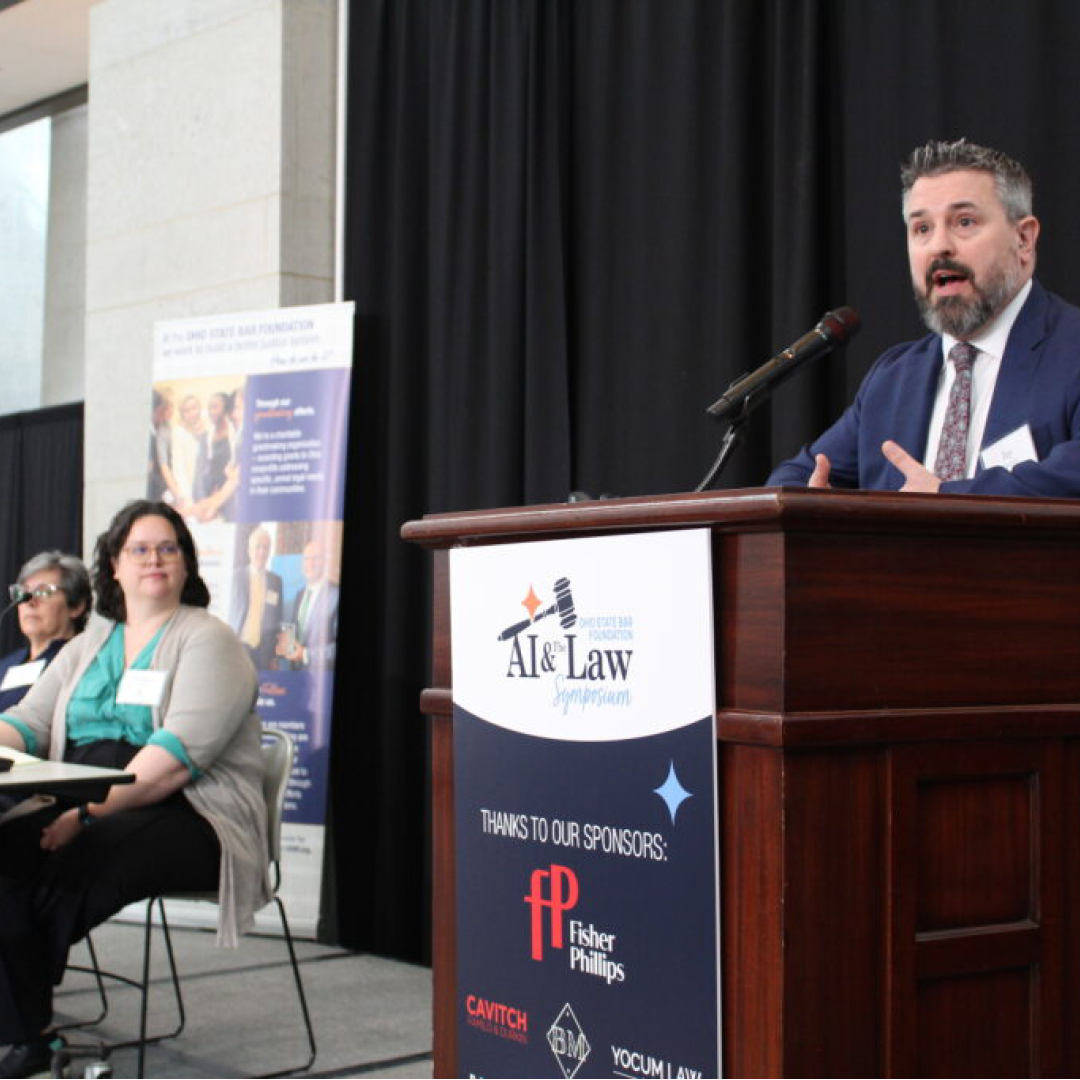
Ohio Assistant Disciplinary Counsel Jay Wampler (right) moderates a panel on practicing law in the 21st century. Photo courtesy of the Ohio State Bar Foundation.
A March survey found that more than 90% of attorneys worldwide are using at least one artificial intelligence tool in their daily work.
Those AI tools come in different packages – an application that checks grammar in a brief, or a resource for attorneys within a legal research product. And there’s generative AI, which can be used to draft a document based on specific directions, or prompts.
Some uses of AI have raised concerns in the legal profession. More than 350 cases in the United States have been documented of attorneys who have filed legal documents with fabricated citations, said Jeremy Kahn, AI editor for Fortune magazine. AI’s exaggerated claims or made-up information, such as fake citations, are called “hallucinations.”
Kahn spoke at a recent Ohio State Bar Foundation event in Columbus on the growing impact of AI on the legal profession. Two panels, which included attorneys, a law professor, and a judge, then delved into the benefits and risks of integrating AI into legal work for the audience of mostly attorneys and judges.
The panelists noted an array of AI upsides. Judge Scott Schlegel of the Fifth Circuit Court of Appeal, State of Louisiana, who has been testing AI and speaks on the topic nationally, pointed out that AI legal research tools can check for mistakes and inconsistencies in documents and can streamline sleuthing through a case record to find sections that are relevant and on point. AI can be a valuable assistant for attorneys and courts, he said.
He noted, too, that relying on AI for decision-making in courts would be problematic. He gave as an example a child custody case where using one AI product grants custody to one parent, but another AI product gives custody to the other parent. Judge Schlegel said it’s not part of the social contract to turn over the human judgment of a judge to AI.
“Right now, courts are only dabbling with AI. Because it’s not our job to be first, it’s our job to get it right,” he said. “When a judge makes a mistake, that’s the law, that’s precedent.”
Courts are exploring, though, where AI can be effective and how best to use it, he noted.
AI Has Powerful Possibilities, if Tempered With Cautions
Judge Schlegel wants the judiciary to be cautious, but he sees many positive ways for AI to be used. In his own exploration of AI, he believes there is potential in the administration or business of the courts, in the courtroom, and in chambers.
Legal research is the easy AI use that benefits attorneys and courts, he said. Tools that analyze legal briefs, summarize statutes and court decisions, check citations, and more are commonly built into today’s legal research products.
Judge Schlegel also mentioned AI’s ability to produce fast transcripts of courtroom proceedings. That would speed along next steps in a case, such as enabling attorneys to draft motions sooner and more quickly. Drafts would then need to be checked against the certified transcript, he noted. Accelerating the process for attorneys also would help courts move cases promptly through the justice system, reducing backlogs, Judge Schlegel noted.
However, when it comes to judicial officers and law clerks using AI in chambers for writing decisions, he would never recommend it for generating the first draft of a decision. If AI starts off in the wrong direction, it will be hard to recover.
“Because then it’s the tail wagging the dog,” he said. “Rule number 1 with AI is don’t use AI, do your job first,” he said.
Once a case has been analyzed by the court and a direction is developed for the opinion, then judges can figure out how AI can assist, he recommended. He and his law clerks at the appellate court use AI to “chunk the record” – breaking it into sections on specific topics. Another benefit is having AI compile a list of witnesses and evidence and summarize the witness testimony. When judicial staff is writing an opinion, that information can be quickly found and used.
Judge Schlegel stresses, though, that judges and law clerks need to read through the relevant parts of the materials and transcripts to ensure that the AI summaries were correct. That’s because AI can misunderstand the context of testimony – which is “the most dangerous hallucination that’s not talked about” in the law, he said.
Once a judicial officer and staff have done their job, AI could also be employed to rework wording, tighten a paragraph, or check the record for whether something on point was missed, he said.
“AI is a second set of eyes,” he explained.
Learning Legal Skills Essential Before Using AI
Judge Schlegel and other panelists cautioned that when beginning to learn and use AI, people shouldn’t rely on it. Experience is crucial for leveraging it effectively, they explained.
Moritz College of Law Professor Rebecca Fordon noted that law schools are grappling with this issue as they educate the attorneys and judges of tomorrow. Fordon teaches legal research and legal technology and is the Moritz Law Library’s assistant director for innovation, research, and instruction.
She noted that as people use AI and see pretty good results, they start to trust it and become more reliant on it. That’s a danger of AI, she said. To teach law students the legal research skills they need as attorneys, Fordon said instructors often now assign in-class assignments to avoid the temptation for students to use AI.
Law schools want students to understand how to incorporate AI into their work, but students first need to learn where it is useful and where it introduces new risks for their legal work, she explained.
“Students must develop judgment and analysis,” Professor Fordon said. “It’s not enough to click ‘verify’ in a legal research tool. Students have got to read the cases and make the legal analysis complete. We teach students where things go wrong with AI.”
Judge Schlegel noted it’s important for the legal profession to keep its important role in mind.
“Remember what we’re actually doing. We’re talking about people’s lives, people’s children, people’s livelihood,” he said. “Those who forget about the why are the ones who are going to get in trouble when using AI and will hurt the profession.”
The day’s panels also talked about AI’s impact on broader legal profession, covering adherence to attorney ethics rules when using AI; verification of evidence in the age of AI; accessibility for individuals with disabilities when AI tools are used; law firm uses of AI to automate tasks, such as real-time transcription of depositions; AI and the unauthorized practice of law; and whether AI could allow attorneys and firms to offer lower cost legal services. The Ohio State Bar Foundation has made a recording of the wide-ranging discussion available.