Legal Legacy: Human Cannonball Fought for His Right of Publicity And Won
The U.S. Supreme Court ruled in favor of “Human Cannonball” Hugo Zacchini in an Ohio case concerning rights of publicity and the First Amendment.
On June 28, 1977, the Supreme Court of the United States provided a landmark ruling in an Ohio case about a stuntman’s right to protect the commercial use of his identity. This is known as the right of publicity.
Zacchini v. Scripps-Howard Broadcasting Company pitted “human cannonball” Hugo Zacchini against a Cleveland television station. Zacchini claimed his performance at a county fair was filmed and broadcast by the TV station in its entirety without his permission. The high court decided the U.S. Constitution doesn’t grant broadcasters immunity from infringements on an entertainer’s right of publicity, ultimately creating a precedent to protect performers from others seeking to profit from their persona.
The journey to this decision began nearly five years prior, in August 1972, when Zacchini performed his cannonball act at the Geauga County Fair. A reporter from the TV station, which was owned by Scripps-Howard Broadcasting, filmed and showed Zacchini’s entire act on the evening news that night, explicitly ignoring his request not to do so. The entertainer didn’t accuse the station of defaming him in any way, but he sued for damages, claiming the broadcaster violated his right of publicity and unlawfully benefited from his professional property.
Scripps-Howard argued it filmed the performance in a public area and had a First Amendment right to freedom of speech and freedom of the press. Scripps-Howard attempted to defend its interest, claiming that public interest in newsworthy events ensures that news companies are, in general, constitutionally able to report on them. As a broadcaster, it profits from reporting on public events such as Zacchini’s performance, the company conceded.
Zacchini’s case tumbled and twisted through the lower courts before reaching the U.S. Supreme Court. It started in the Cuyahoga County Common Pleas Court in 1973. The trial court sided with Scripps-Howard, and Zacchini appealed to the Eighth District Court of Appeals, where he won. The Supreme Court of Ohio was sympathetic to Scripps-Howard’s arguments and flipped the Eighth District decision, finding that news stations were constitutionally privileged in reporting matters of public interest.
The U.S. Supreme Court disagreed, likening Zacchini’s performance to a patent or copyright, in which broadcasting the event without permission threatened the person’s ability to economically benefit from his own performance. The court decided the First and Fourteenth Amendments to the U.S. Constitution don’t allow media to broadcast an entire act without the performer’s permission. How much the broadcaster should pay Zacchini for violating his publicity rights was a matter the high court did not answer. Instead, it directed Zacchini’s case back to the lower courts to eventually be settled out of court two years after the Supreme Court’s ruling.
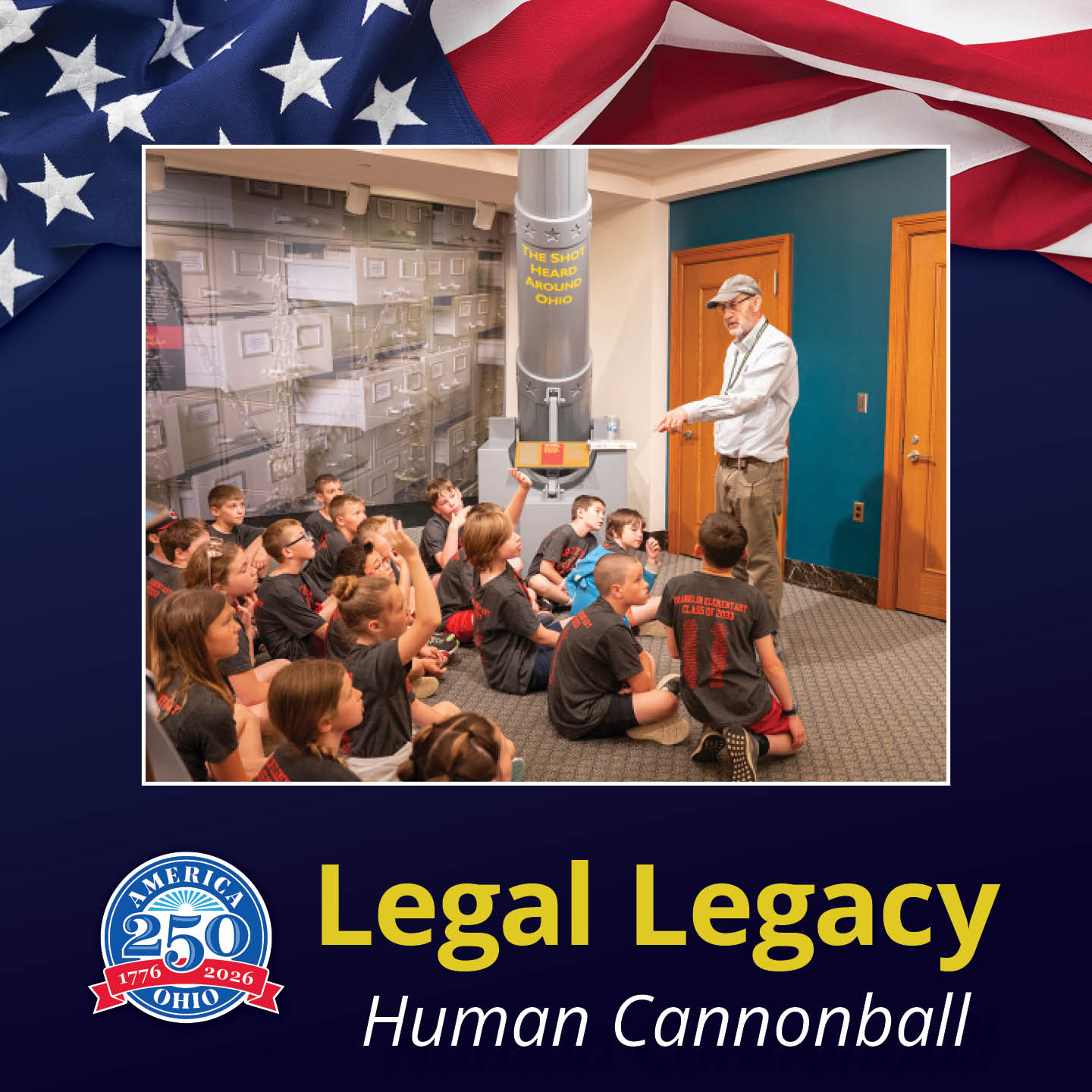
This case is one of several featured in the Visitor Education Center at the Thomas J. Moyer Ohio Judicial Center. Plan a visit to the Court or schedule a free tour by emailing courttours@sc.ohio.gov.
As America is preparing for its 250th birthday on July 4, 2026, the Supreme Court is celebrating the semiquincentennial with a yearlong celebration called “The Story of America,” highlighting significant historical events. Beyond digital content, the celebration includes events and displays at the Court. The initiative aims to spark curiosity, enhance civic literacy, and honor key moments in American and Ohio history.