
Ohio Court Employees Complete Prestigious National Program
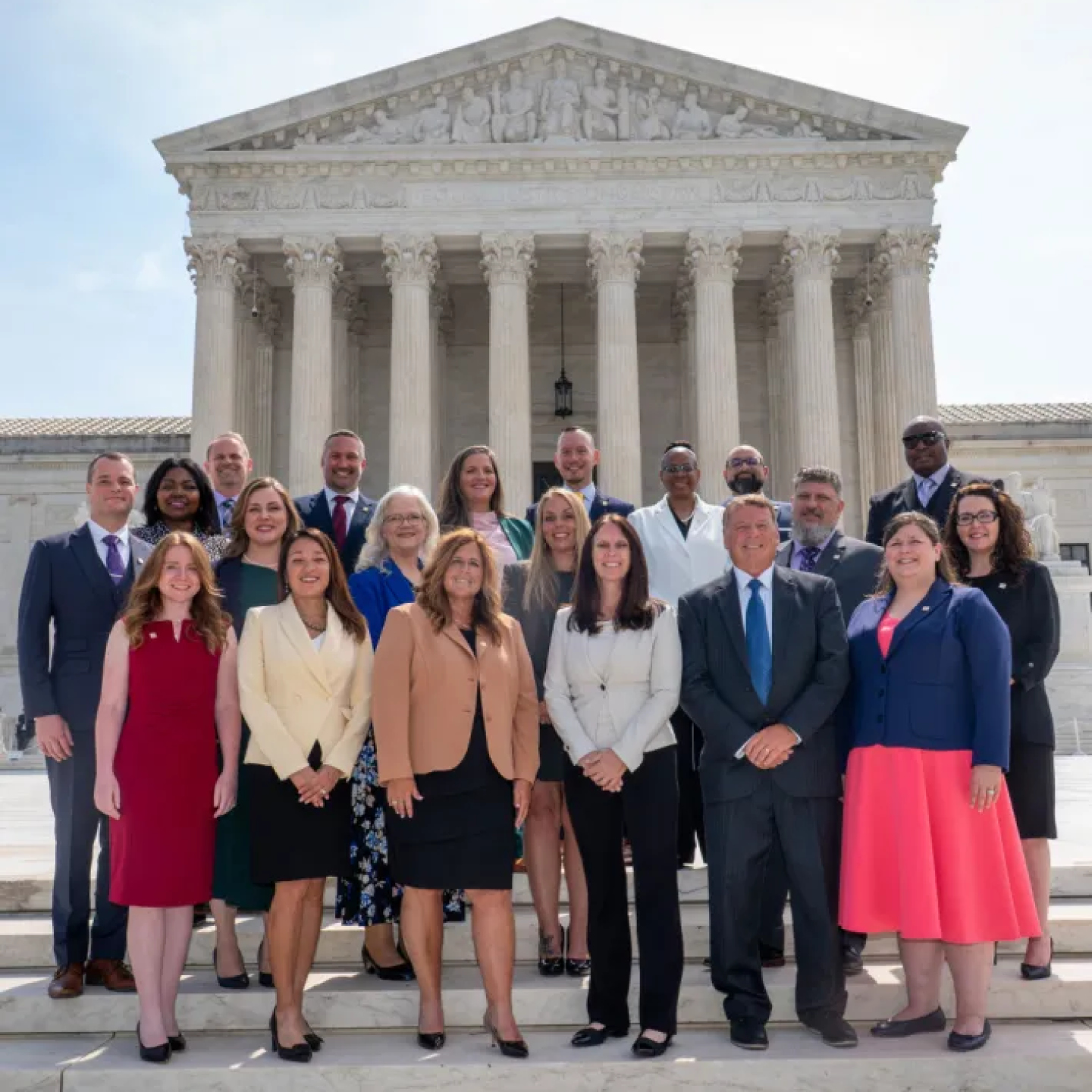
Jennifer Burnside of the Warren County Common Pleas Court (front row, third from left) and Joe Statzer of the Butler County Clerk of Courts (front row, second from right) were among 21 court professionals recognized at the U.S. Supreme Court for graduating from a prestigious national program.
A court administrator and a chief deputy clerk from two Ohio courts have graduated from a national program, concluding individual research projects and gaining valuable experience to strengthen the state judicial branch.
Jennifer Burnside, court administrator for the Warren County Common Pleas Court, and Joe Statzer, chief deputy at the Butler County Clerk of Courts, each achieved the top-level designation as fellows from the Institute for Court Management (ICM), part of the National Center for State Courts.
Burnside and Statzer were among 21 court professionals from 13 states who earned the respected leadership designation this year. Their latest achievement builds on the knowledge and skills they gained to become Certified Court Managers and Certified Court Executives through the ICM and the Supreme Court of Ohio Judicial College. This summer’s recognition of Burnside, Statzer, and other court professionals through the fellows program reflects months of rigorous study, research, and practical application aimed at improving courts and the communities they serve.
Research Projects: Interactions Between Judges and Clerks, Juror Trauma
Statzer’s research focused on the relationships between judges and clerks of courts and how their interactions can affect good government in the state. Judges and clerks are elected to their positions in Ohio. Statzer noted that most judges and clerks have positive relationships, but when there are conflicts, complications for their courts, and even litigation, have resulted. Statzer said that one of his research-based recommendations for such conflicts likely will come as no surprise.
“Frequent and open communication between judges, clerks, and court administrators is key, as it is often lacking,” he said.
He found that clear and candid discussions on issues such as role clarifications, changes in information technology, and records management responsibilities are essential for productive relationships.
For her project, Burnside investigated the trauma that jurors can experience when performing this civic duty for courts. She explained that jurors involved in difficult trials are often exposed to graphic evidence and traumatic testimony and must make decisions that have significant consequences in someone’s life. She found that approximately one-third of jurors reported increased trauma-related distress after a trial. Based on the screening tool used, 17% of those jurors remained at a level of clinical concern or higher, including 11% in the range associated with probable PTSD.
“After service, they are typically thanked and dismissed with little information about possible emotional effects,” Burnside said. “While the assessment is not a clinical diagnosis, the results indicate that difficult trials can have a meaningful emotional impact on some jurors.”
She hopes the project increases awareness of what some jurors experience and provides courts with practical ways to support them before, during, and after difficult trials. Those supports could include courts preparing jurors for common stress reactions, checking in with jurors after trials, providing resource information, and ensuring that alternate jurors are not overlooked, Burnside said.
Participants Spend 16 Months Studying and Completing Projects
Burnside and Statzer celebrated their graduations during a ceremony at the U.S. Supreme Court earlier this summer. They now join a distinguished network of more than 1,300 alumni – 38 from Ohio – who have completed the ICM fellows program. Statzer applauded it.
“The amount of knowledge I learned in the program – about courts and judicial governance – was priceless,” he said.
The program, which spans 16 months, encompasses coursework; a short residency in Williamsburg, Virginia; a supervised research project and court improvement plan; and a final presentation. The program reinforces the use of evidence-based decision-making. After completing their independent, research-based court improvement project, participants graduate with the equivalent of a master’s degree thesis.
“The research projects with this group moved beyond theory to deliver practical, evidence-based recommendations that can strengthen courts and improve the administration of justice,” said ICM Fellows Dean Marcus Reinkensmeyer. “Equally impressive was their class culture – one of collaboration, mentorship, and lasting support.”