
Legal Legacy: Chief Justice Thomas J. Moyer
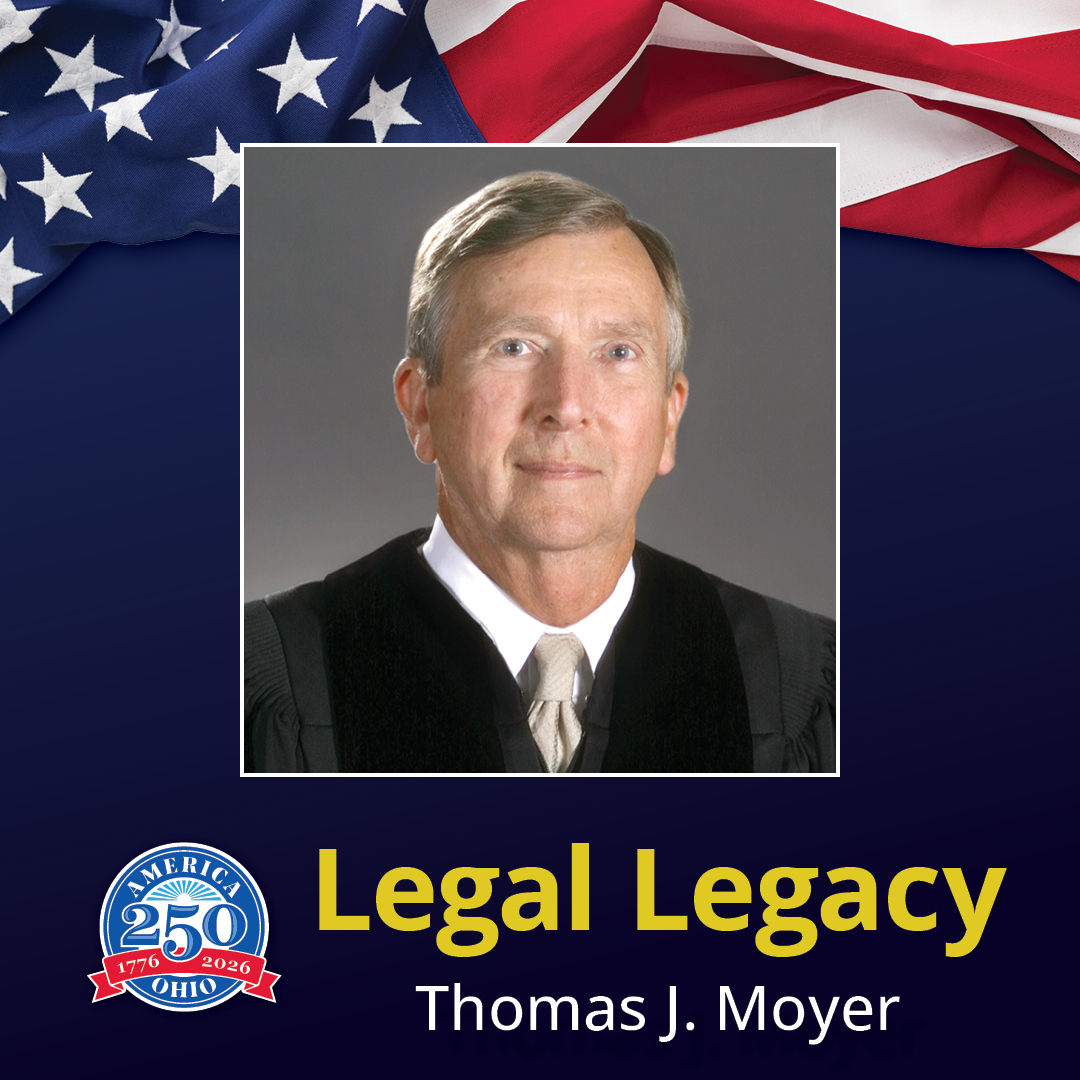
Thomas J. Moyer served as chief justice of the Supreme Court of Ohio for more than two decades. During his tenure, he ushered in a wave of modernization and reform, with leadership that extended well beyond the courtroom and reshaped how Ohio’s courts functioned.
Born April 18, 1939, in Sandusky, Moyer earned his bachelor’s degree in political science and his Juris Doctor from Ohio State University. Before joining the Supreme Court, he built a distinguished career in both private practice and public service. He served five years on the Columbus School Board, including two as president. His judicial career began in 1979, when he was elected to the Tenth District Court of Appeals in Franklin County.
Moyer was elected chief justice in 1986, taking office in January 1987. He served in that role until his death in 2010, the second longest serving chief justice in Ohio history.
Improving the efficiency and administration of Ohio’s judicial system was a defining priority of Moyer’s tenure. He emphasized education across the judicial branch, supporting the expansion of the Ohio Judicial College to provide training for magistrates beginning in 1988 and for additional court personnel in 1990. These statewide training opportunities strengthened court operations and promoted the effective administration of justice throughout Ohio.
Under Moyer’s leadership, Ohio also became the first state in the country to offer the Court Management Program on a statewide basis. The program improved consistency among the courts, accelerated case administration, and reduced delays, advancing a more modern and responsive judiciary.
Beyond procedural reforms, Moyer played a central role in establishing a permanent, centralized home for the Supreme Court of Ohio through the restoration of the Ohio Departments Building, which became the Ohio Judicial Center. This marked the first time in state history that the Supreme Court was housed in its own dedicated facility, separate from other state offices. Under his vision, the historic but underused building was transformed into a functional space for the entire Court, while preserving its architectural significance. The project reflected Moyer’s broader commitment to strengthening the Court as an institution, operationally, and its public presence.
Moyer also established the Court’s Off-Site program in 1987 as part of a national and statewide effort to commemorate the 200-year anniversary of the signing of the U.S. Constitution. Designed to give Ohioans a clear understanding of the judicial branch, Chief Justice Moyer launched an 18-month tour with seven stops. Nearly four decades later, Off-Site Court continues to serve as a cornerstone of civic education about the judicial branch in Ohio.
In 2011, the building was renamed the Thomas J. Moyer Ohio Judicial Center in recognition of his enduring contributions to Ohio’s judiciary. The designation honors not only his leadership in restoring the building, but also lasting impact on the state’s court system.
Sixteen years after his death, Moyer’s legacy continues through the administrative practices and structural improvements he championed, many of which remain in place today. His tenure helped shape a more contemporary court and reinforced the judiciary’s vital role in serving the public.
As America is preparing for its 250th birthday on July 4, 2026, the Supreme Court is celebrating the semiquincentennial with a yearlong celebration called “The Story of America,” highlighting significant historical events. Beyond digital content, the celebration includes events and displays at the Court. The initiative aims to spark curiosity, enhance civic literacy, and honor key moments in American and Ohio history.