
Legal Legacy: Ohio Court Decides Landmark Case on School Sports Eligibility
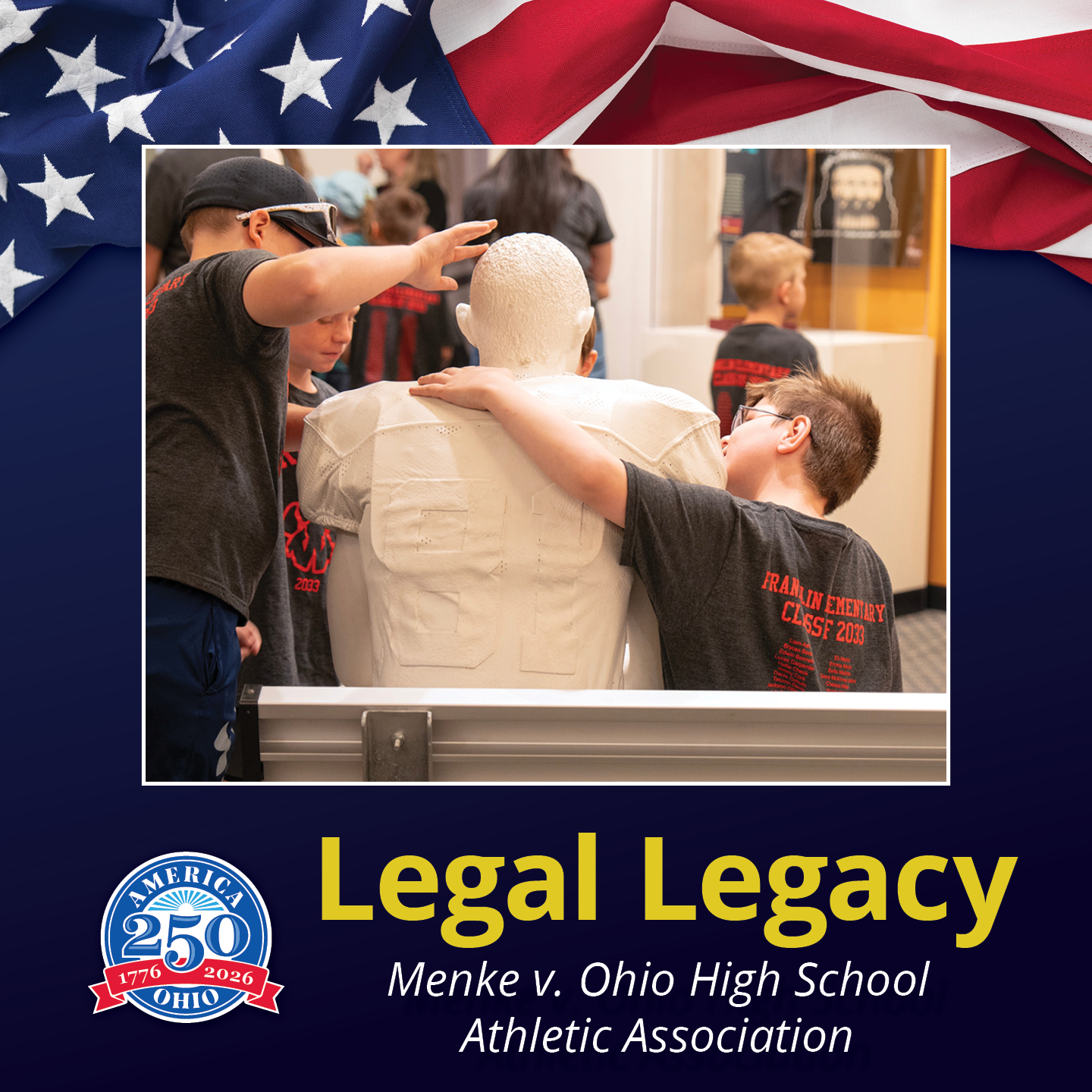
On this day in 1981, Menke v. Ohio High School Athletic Association was decided by the First District Court of Appeals in Ohio.
Forty-five years ago today, on Sept. 16, 1981, the First District Court of Appeals decided a landmark case in Ohio concerning issues of education and equal protection. Menke v. Ohio High School Athletic Association considered whether students are eligible to play sports in a state where the student does not reside. The court grappled with the issue of whether playing school sports is part of a student’s right to an education.
During the 1980-1981 school year, several Kentucky residents were enrolled in St. Xavier High School in Cincinnati. As a member of the Ohio High School Athletic Association (OHSAA), St. Xavier didn’t allow these students to participate in school sports because it was bound by the association’s Rule 9-2g, which stated: “[A] student whose parents live in another state will be ineligible for athletics in an Ohio member school.”
The Kentucky students sued the OHSAA, claiming the rule violated their constitutional rights to education and equal protection under the law. The Hamilton County Common Pleas Court considered the case, and sided with the OHSAA. The students appealed their case to the First District.
The First District ruled that out-of-state high school athletes don’t comprise a suspect class, which would have entitled them to protections under the U.S. Constitution, and that education is not a fundamental right. The appeals court upheld the lower court’s decision. As a result, out-of-state students weren’t entitled to constitutional protections because playing sports is only one part of an education, the appeals court ruled.
Decision’s Significance Lives on Today
The original case’s logic has been extended to other educational controversies, including cases concerning students’ grade-point averages, access to public busing for private schools, and random drug testing.
The Menke decision was first referenced in the West Virginia case Bailey v. Truby, which was decided in 1984. The case considered the fairness of requiring student athletes to maintain a 2.0 grade-point average and cited Menke as evidence that participation in extracurricular activities isn’t constitutionally protected.
In 2025, Menke was cited in two case decisions: Swiech v. Sylvania City District Board of Education and Desavigny v. Baker. The issue in the first of these cases was whether public school districts were responsible for developing special bus routes and transporting students who attended private schools in the area. The Sixth District Court of Appeals in Ohio cited Menke in concluding that because education isn’t a fundamental right, there can be no fundamental right to receive transportation to school. Desavigny was concerned with a school removing a student from participating in school sports after random drug testing and cited Menke’s finding that participation in athletic competitions isn’t guaranteed.
Since the 1981 decision, Menke has been cited 15 times by seven state courts and three times in two federal courts – across eight states, including Ohio.
Plan a visit to the Court to see the display about this case along with several others that are featured in the Visitor Education Center at the Thomas J. Moyer Ohio Judicial Center.
America commemorated its 250th birthday on July 4, 2026, marking a historic milestone in the nation's journey. To honor the semiquincentennial, the Court hosted a year-long celebration titled “The Story of America,” highlighting significant historical events that shaped both the nation and Ohio. In addition to digital content, the initiative has featured special events and exhibits at the Court. The celebration aims to spark curiosity, strengthen civic literacy, and recognize pivotal moments in American and Ohio history.