
Legal Legacy: Court Decides When Police Can Search Vehicle
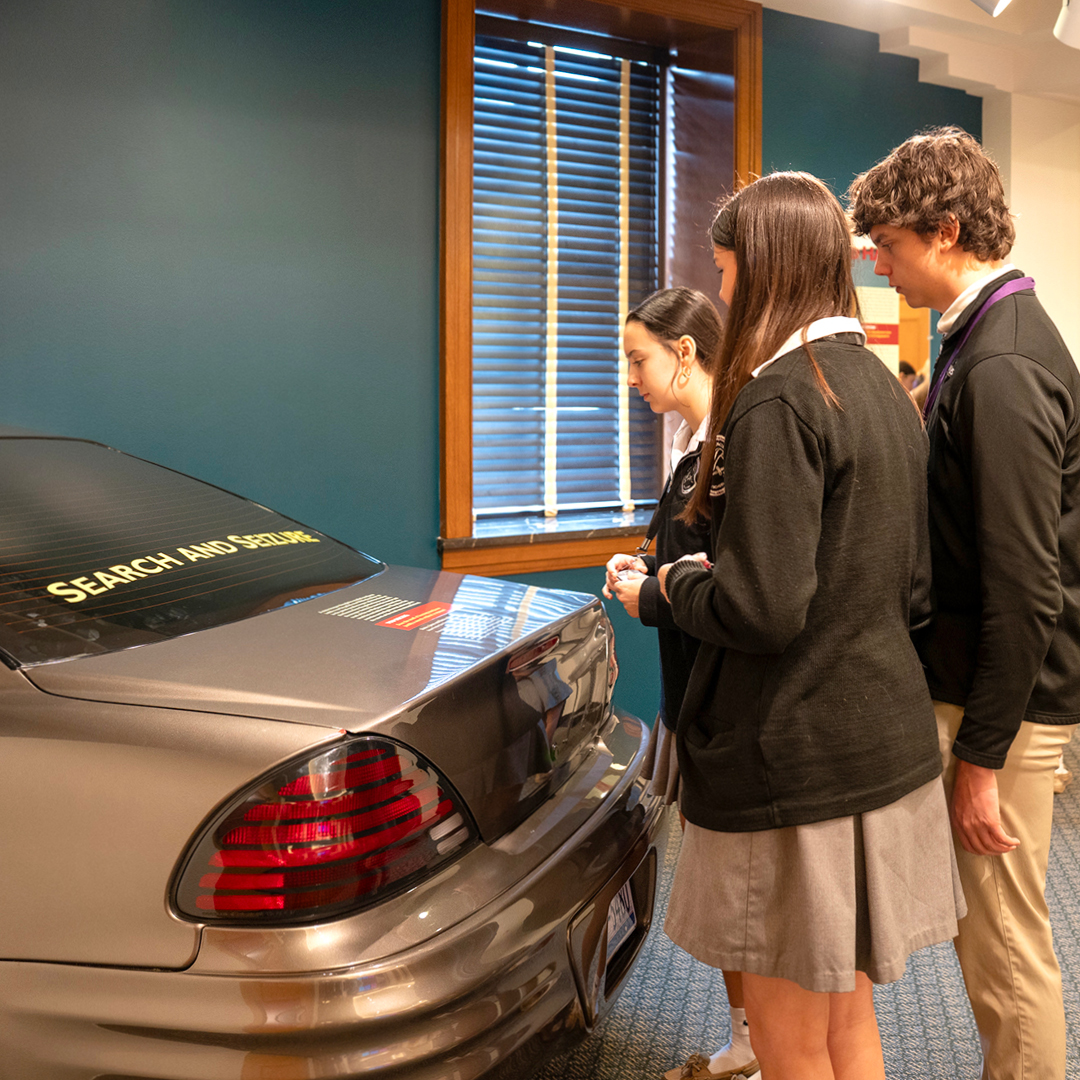
Students explore the State v. Moore exhibit in the Moyer Judicial Center’s Visitor Education Center.
Sept. 20 marked the 26th anniversary of a landmark Supreme Court of Ohio decision interpreting the prohibitions in both the U.S. and Ohio constitutions on unreasonable searches and seizures as it relates to searching a vehicle based on the smell of marijuana.
To recognize the 2000 decision in State v. Moore, an exhibit was created in the Supreme Court’s Visitor Education Center to help students understand the Court’s decision-making process and how courts balance the application of the law, constitutional rights, and the facts of a case.
The exhibit, in fact, discusses two related cases. In the Moore case, Christopher Moore was pulled over by Ohio State Highway Patrol Sergeant Jeffrey Greene for running a red light. When Greene approached the car and the window was rolled down, he could smell the odor of marijuana from the vehicle. Greene then searched Moore and his vehicle and found drug paraphernalia and a burnt marijuana cigarette. The trial court originally considered the search to be illegal; however, the appellate court and the Supreme Court of Ohio reversed that interpretation. The Supreme Court ruled that “the smell of marijuana, alone, by a person qualified to recognize the odor, is sufficient to establish probable cause to conduct a search.”
Constitutional interpretations can change over time. As the exhibit notes, two years earlier, in State v. Jones, the Fifth District Court of Appeals ruled that searching a vehicle based on smell alone wasn’t enough to justify a search. The appellate court noted that “we find suspicious odors must be confirmed by tangible evidence in order to justify a search.” With the new set of facts and circumstances presented in the Moore case, the Supreme Court reinterpreted when Ohio law enforcement can lawfully conduct a search if they encounter the smell of marijuana from a vehicle.
Visitors to the Visitor Education Center at the Thomas J. Moyer Ohio Judicial Center have the chance to discuss the Moore and Jones cases, including how courts balance a person’s right in the Fourth Amendment of the U.S. Constitution to be free from unreasonable searches and seizures with concerns about public safety, such as when someone drives while inebriated. In the time since the Moore decision, marijuana laws have changed, which has added to the conversation and nuances of the application of this case today.
This case is one of several featured in the Visitor Education Center. Cases are selected to illustrate the importance of Ohio’s judicial system and its role in interpreting the law. See all the case exhibits, and learn more about the courts, on a free tour! Call 614-387-9223 or email CourtTours@sc.ohio.gov to schedule.