
Legal Legacy: The Magna Carta to Modern Law
A look back at how the “Great Charter” has shaped the legal system
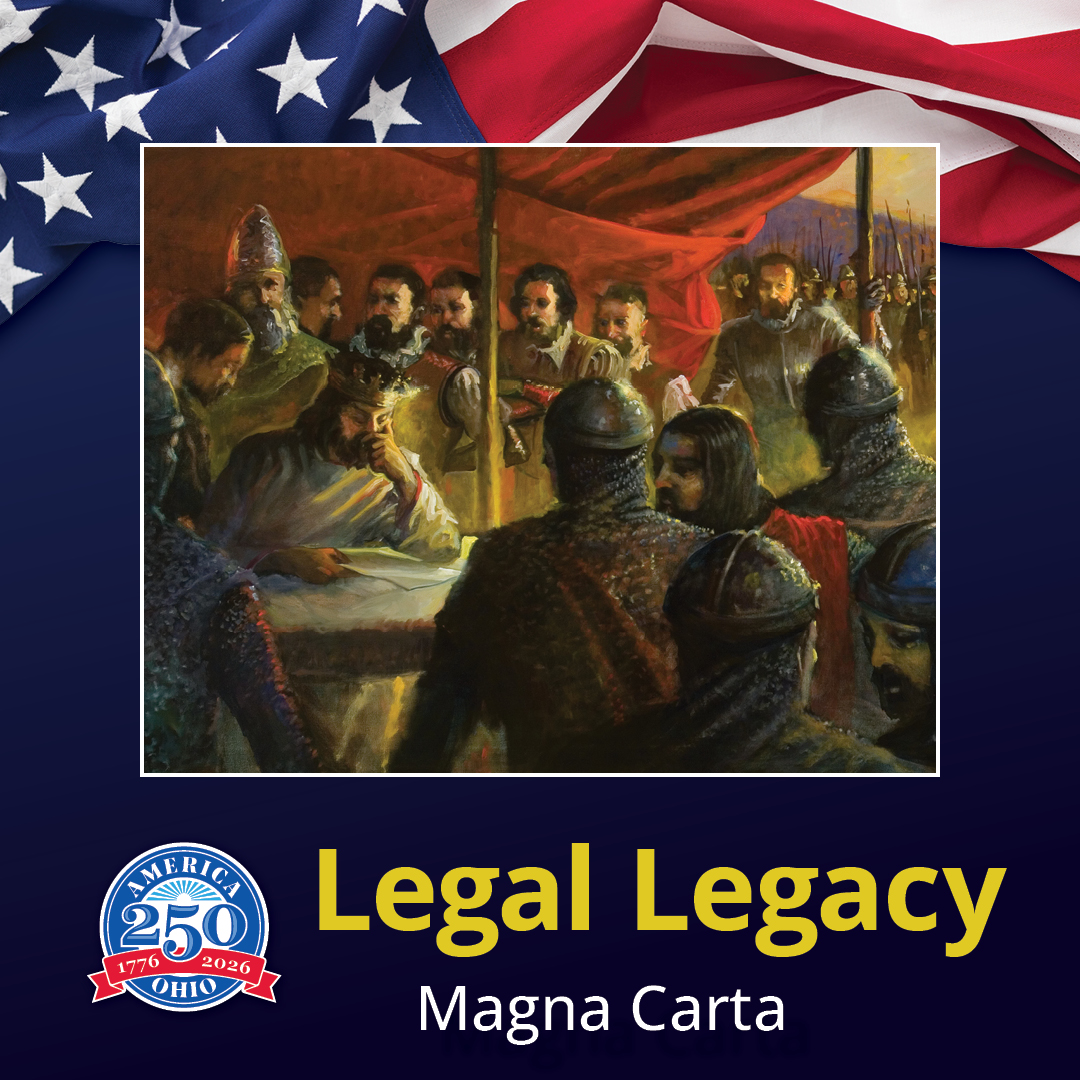
The Signing of the Magna Carta, Ron Anderson, 2005, oil on canvas. On view in the Rule of Law gallery in the Law Library, 11th floor.
On May 1, 1958, the United States celebrated its first Law Day, as ordered by President Dwight D. Eisenhower. Since that inaugural observance, Law Day has served as an annual reminder of the rule of law and its importance in promoting liberty and justice.
This year, the Supreme Court of Ohio is recognizing one of the earliest and most enduring influences on the American legal system: the Magna Carta.In 1215, a group of English barons confronted King John, demanding that traditional rights be upheld. The king agreed, albeit under duress, to put those demands in writing and authenticate with a royal seal. The resulting document, known as the “Great Charter,” or Magna Carta, obliged King John and his heirs to grant certain rights and liberties “to all free men” of the kingdom.
Although the Magna Carta was reissued several times between 1215 and 1297, mounting dissatisfaction with King Edward I’s heavy taxation led to another confrontation with the barons of England. This time, the reissued Magna Carta was formally entered into the official Statute Rolls of England, transforming what began as a brokered deal into a foundational document of English law.
While the original document primarily addressed medieval rights and customs, the Magna Carta has since become a powerful international symbol of the rule of law. Elements of the United States Bill of Rights reflect its influence. In particular, the Fifth Amendment echoes the principle set forth in Clause 39 of the original Magna Carta: that no person should be denied justice or a fair trial.
Today, only four clauses from the original 1215 Magna Carta remain in force. Nevertheless, its spirit lives on in cornerstone legal documents, including the Declaration of Independence, the United States Constitution, the Universal Declaration of Human Rights, and the International Covenant on Civil and Political Rights.
The enduring legacy of the Magna Carta stands as a testament to the importance of the rule of law and justice, principles that Americans reflect upon each year on Law Day.
As America is preparing for its 250th birthday on July 4, 2026, the Supreme Court is celebrating the semiquincentennial with a yearlong celebration called “The Story of America,” highlighting significant historical events. Beyond digital content, the celebration includes events and displays at the Court. The initiative aims to spark curiosity, enhance civic literacy, and honor key moments in American and Ohio history.