Ohio Courts Serve as Models for Helping Vulnerable Youth
Courts in eight counties are finding success with tailored programs to identify and help youth involved in both the child welfare and juvenile justice systems.
Children involved with both the child welfare system and juvenile courts tend to be at risk for future problems in the justice system. Successes in Ohio courts to better assist these youth are being commended and shared nationally as models.
Eight Ohio courts have implemented programs designed to ensure that youth who come into contact with child welfare and juvenile justice systems are properly identified and helped. At their core, the programs for dually involved youth coordinate and integrate the activities and services across the systems. A common scenario is a child who has experienced abuse or neglect, is placed temporarily or longer outside of the child’s home, and at some point is also facing a delinquency allegation in a juvenile court for an offense. Youth who encounter issues like abuse and neglect and enter the child welfare system find themselves on a downward trajectory with an elevated likelihood of being arrested at younger ages, more frequently, and later as adults, according to research documented by the National Resource Center for the Transformation of Youth Justice.
That downward trajectory comes with a toll – on the children caught in the cycle, and from the financial costs of placing children outside of their homes, states a report from the national center. The center received a grant from the Supreme Court of Ohio to partner with and offer technical assistance to Ohio courts developing programs for dually involved youth. The goal is to interrupt the repeating patterns, leading to benefits for the youth, their families, and their communities.
Two of the participating Ohio courts – Fairfield County Juvenile Court and Hancock County Juvenile Court – were featured last summer at a national symposium coordinated by the center. Presenters from the courts discussed the framework and practices for assisting these challenging and vulnerable youth as well as specific court experiences. More than 120 state and local courts and probation agencies from 33 states were represented at the symposium. Ohio judges and court staff also have spoken at a national webinar and a Supreme Court roundtable on the topic.
The Fairfield County Juvenile Court was in the first group of four courts to start a program in Ohio. Makaila Tussing, the court’s specialized docket and strategic initiatives program coordinator, said the program allowed the county to develop a tailored approach for identifying these youth. Expectations also were established for court and child protective services staff to effectively work together and deliver services.
Historically, coordination for dually involved youth across child welfare organizations, courts, and behavioral health providers has been limited due to separate statutory requirements, different funding mechanisms, and information-sharing constraints. Tussing said children and families in Fairfield County who cross into both systems are now found earlier, and families gain a better awareness of everyone on the team assisting them.
“Having their voices lifted up and a clear understanding of the people at the table to support them has resulted in increased youth and family engagement,” she explained. “Our feedback surveys indicate that families feel supported by their teams to create positive change within their families, and they are able to share needs openly with the court and protective services.”
Among the positive outcomes Ohio courts have achieved to date with their initiatives for dually involved youth:
- With increased cross-system collaboration, teams of professionals are finding expanded opportunities for stable placements, connections to services, and community supports not previously on their radar as viable interventions.
- Youth who typically haven’t been eligible for diversion from prosecution but are at low risk to reoffend are qualifying for diversion programs.
- Connections with OhioRISE, which coordinates behavioral health care for children, have improved and resulted in better access to necessary treatment aimed at increasing the stability of placements and reducing risks for the youth and family.
- Youth placed in secure settings, including detention centers and residential facilities, are experiencing shorter stays in the facilities.
- Two counties reported lower recidivism rates for moderate- and high-risk youth who were identified in their programs as dually involved youth.
The Clark County Juvenile Court has also built a program for dually involved youth. Judge Katrine Lancaster said their community identified precise outcomes needed to address the critical needs of the high-risk group of youth.
“The most important discoveries in our journey resulted in 1) stronger understanding of the youth involved in both juvenile justice and child welfare and the necessity to coordinate our agency efforts on their behalf; 2) specifically identifying the additional services needed in our community to assist in providing the best outcomes for our youth; and 3) the significance of data collection to tell the accurate story of impact,” Judge Lancaster said.
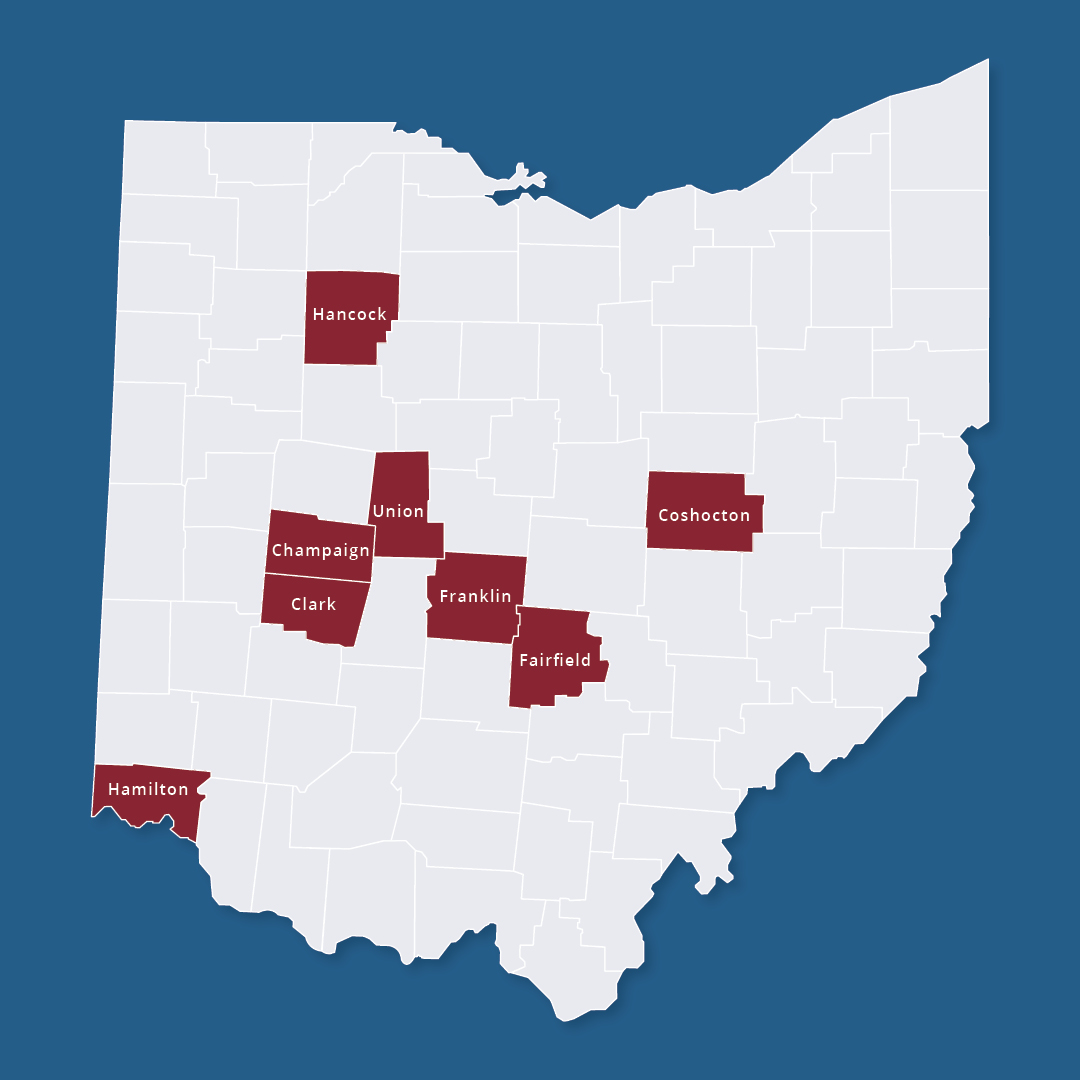
The work is ongoing in the first group of four courts in Champaign, Clark, Fairfield, and Hancock counties. The project now includes four more Ohio courts – in Coshocton, Franklin, Hamilton, and Union counties – with hopes to expand on the successes.
From the data gathered from the first four courts, nine markers of progress have been identified to assist other courts in Ohio and nationally. The markers reflect the need for a strong leadership collaboration across multiple partners (such as child welfare/protective services, juvenile court, probation, prosecutors, defense counsel, law enforcement, behavioral health, and others) with a structure for formal oversight. In addition, it is crucial to precisely define the attributes of the target population of dually involved youth to be served, the specific point when they will be identified, and the outcomes to be catalogued, along with processes for data collection and reporting.
“Overall, the initiative provided us with the opportunity to imagine and implement a more effective way to provide services for dually involved youth and obtain the best outcomes for our youth,” Judge Lancaster said.