
Supreme Court Commissions Highlight Work of 2025
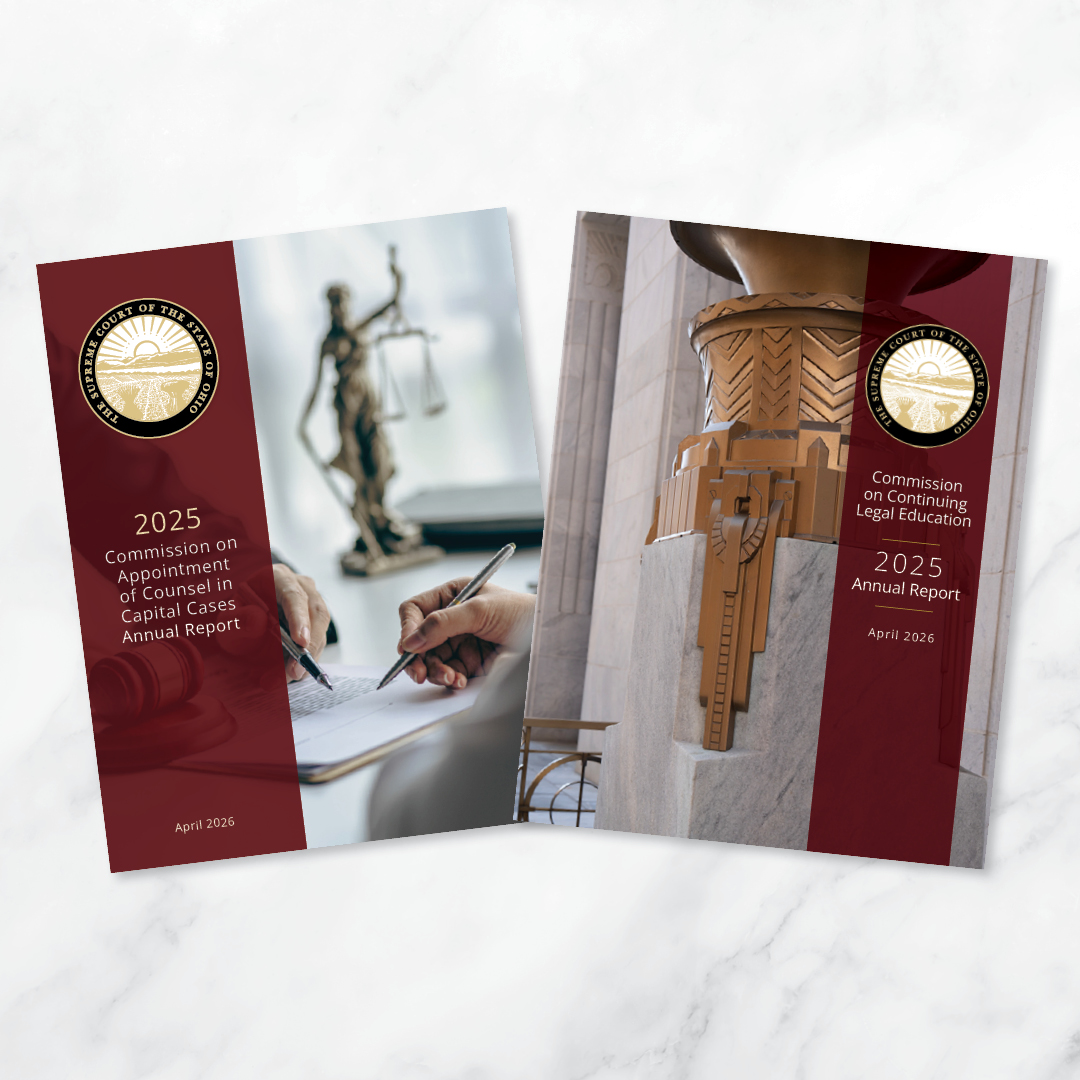
Two commissions of the Supreme Court have published their annual reports.
The commissions of the Supreme Court of Ohio that oversee continuing legal education (CLE) and attorney appointments in capital cases have published their annual reports.
The Commission on Continuing Legal Education and the Commission on Appointment of Counsel in Capital Cases are among several commissions that help the Supreme Court meet its constitutional and statutory authority to exercise general superintendence over the courts in the state and provide oversight of the practice of law.
CLE Commission Annual Report
The CLE Commission is charged with administering and regulating attorney and judge compliance with the Court’s rules governing CLE. The 2025 annual report notes that the commission, through the Court’s Registration and CLE staff, reviewed more than 29,000 applications from course sponsors requesting approval of classes to offer as CLE for the legal profession.
Also in 2025, the Court adopted amendments to the CLE rules to require acting judges to register with the commission prior to appointment, in addition to annually thereafter. The change, which took effect Jan. 1, 2026, helps to ensure the correct CLE requirements are applied to acting judges throughout their entire appointment.
The commission is required to report, at least annually, its activities and the status of CLE in the state to the Court.
Appointment of Counsel in Capital Cases Commission Annual Report
The Commission on Appointment of Counsel in Capital Cases administers the requirements for appointing counsel in cases where a sentence of death could be imposed. Among its duties, the commission certifies attorneys with required experience and CLE training as eligible to be appointed to represent capital defendants who are financially unable to pay for an attorney.
The commission’s annual report highlights a statewide survey conducted in 2025. The survey was distributed to Ohio criminal defense attorneys to better understand barriers to obtaining or maintaining certification for capital litigation, particularly given a declining and aging pool of attorneys certified for these cases.
As part of the findings, the commission clarified that when the lead counsel and first co-counsel are certified for capital cases, the second co-counsel doesn’t need to have certification. The commission encouraged the appointment of a second co-counsel in pending or future capital cases to help less experienced attorneys gain the skills and experience to obtain certification in the future. The goal with this information is to help strengthen and expand the pool of attorneys certified to represent indigent defendants in capital cases going forward.
The commission is required to submit an annual report to the chief justice, justices, and administrative director detailing the commission’s activities and accomplishments for the year and its anticipated activities during the upcoming year.
Commissions are created by action of the Supreme Court and operate under rules or regulations adopted by the Court. Members are appointed by the chief justice and justices; because they hold a position within a group, organization, or association; or because they have been nominated by that entity. Commissions are comprised of judges, attorneys, clerks of court, other court personnel, and private citizens from throughout Ohio.