
Settlement Week Successes Expand
More courts gave Settlement Week a try in 2025 and resolved hundreds of cases.
For nearly two years, a contentious commercial case was pending in Summit County Common Pleas Court. The dispute involved allegations of breach of contract, fraud, and other complex claims. Mediation was tried months earlier, but no resolution was found.
In another attempt to conclude the case, it was scheduled for the court’s Settlement Week. During a Settlement Week, a court designates specific days to have mediators work on a selected group of cases. The parties agree to participate in the program. A mediator, who is a neutral person not involved in the case, guides the participants as they work to resolve their differences during the confidential discussions.
In the Summit County case, staff assigned a volunteer with expertise as a former litigator to mediate the case and gave the mediation a three-to-four-hour time block, one of the court’s longest. The result was a successful resolution.
“The ability to match a complex and difficult case with a mediator who has significant experience handling similar cases is one of the unique benefits of hosting a Settlement Week,” Magistrate William Rininger said. “The parties and the attorneys were happy and satisfied to finally put the matter to rest.”
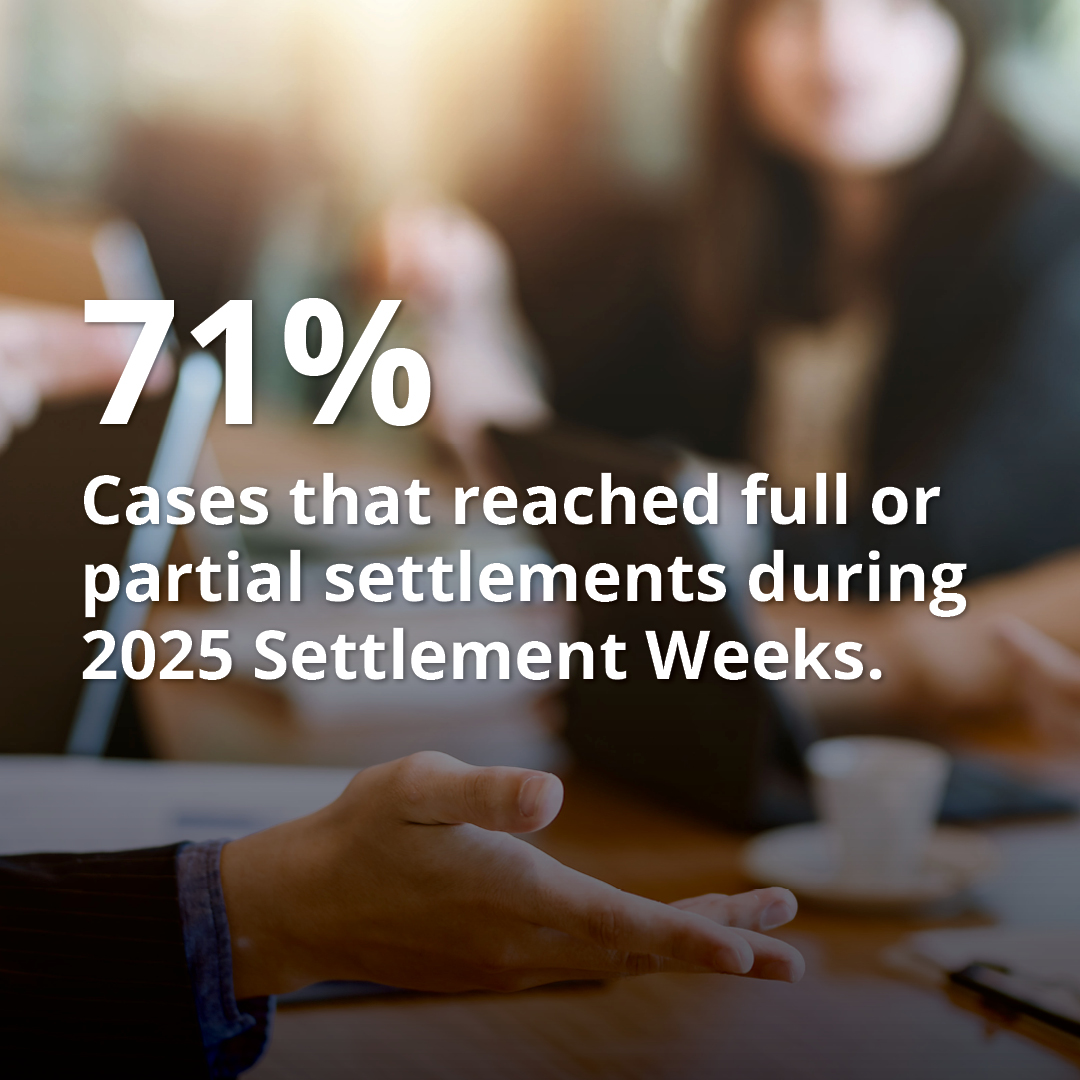
At that October Settlement Week in Summit County, 61 cases were mediated and 60% settled partially or fully. Such successes have been rising across the state, as more Ohio courts give Settlement Week a try. After Supreme Court of Ohio Chief Justice Sharon L. Kennedy designated 2025 as the Year of the Settlement Week Sweep, 10 courts held events last year, double the number that conducted them in 2024. In those 10 courts, 303 cases were mediated during a Settlement Week, with 71%, or 215, reaching a full or partial settlement.
The five courts holding their first Settlement Week in 2025 were:
- Hamilton County Common Pleas Court, Domestic Relations Division
- Hamilton County Common Pleas Court, Juvenile Division
- Hancock County Common Pleas Court, Probate and Juvenile Division
- Lorain County Common Pleas Court, Domestic Relations and Juvenile Division
- Medina County Common Pleas Court, Domestic Relations Division
Deliberate Focus on Settlement Resolves Cases
Rininger noted that the Summit County Common Pleas Court is fortunate to have a mediation department, which tackles an average of 30 cases each week. But Settlement Week accelerates the number of cases that can be resolved by freeing up court schedules that are typically filled with conferences, hearings, and trials. Since the court revived Settlement Week in 2024, Rininger said more than 100 cases are referred for each one.
“Being able to conduct three to four weeks’ worth of mediations in one week of Settlement Week is a tremendous benefit to parties with cases before the court,” he said.
In Medina County Common Pleas Court, the domestic relations division focused its Settlement Week on cases involving families in conflict. Judge Julie Schafer noted that not every domestic relations case is appropriate for Settlement Week. However, the program can be particularly effective for cases with complex issues, such as ongoing relationships, coparenting dynamics, and highly emotional circumstances, she explained.
“Parties are frequently navigating personal conflict, financial stress, and uncertainty. Meaningful resolution often requires more than a brief court appearance or a traditional litigation schedule can provide,” Judge Schafer said.
At the court’s August Settlement Week, 31 cases were mediated, with approximately 60% fully or partially settled the same day. Statewide, courts implementing Settlement Weeks have reduced the number of civil cases on their dockets, opening up more time for complicated cases that require trials. Judge Schafer said the events also reinforce collaboration among court staff, mediators, attorneys, and community stakeholders, which cascades into other benefits.
“The collaboration also helps build public confidence in the court as an institution committed to accessibility, efficiency, and meaningful service to parties,” she said.
Rininger agrees, noting that many times a person involved in a case is directly interacting for the first time with the court during Settlement Week.
“It gives a court the golden opportunity to engage the public,” he said. “A Settlement Week mediation may help to make the court process less opaque and mysterious. Participants will see that their case has been matched with an experienced and unbiased mediator, they have been given time and space to voice their opinions and concerns about the case, and it is being handled with the attention and care it deserves.”
Support Available for Courts
To assist courts with conducting a Settlement Week, the Supreme Court Dispute Resolution Section has collected resources on the Supreme Court website. There’s a short informational video, overview of the process, mediator requirements, and sample forms and documents that can be adapted locally. The Court also periodically holds courses and roundtables about Settlement Week for court staff.
To learn more about Settlement Week, contact DisputeResolution@sc.ohio.gov.