
Importance of Free Speech Highlighted at Civility Symposium
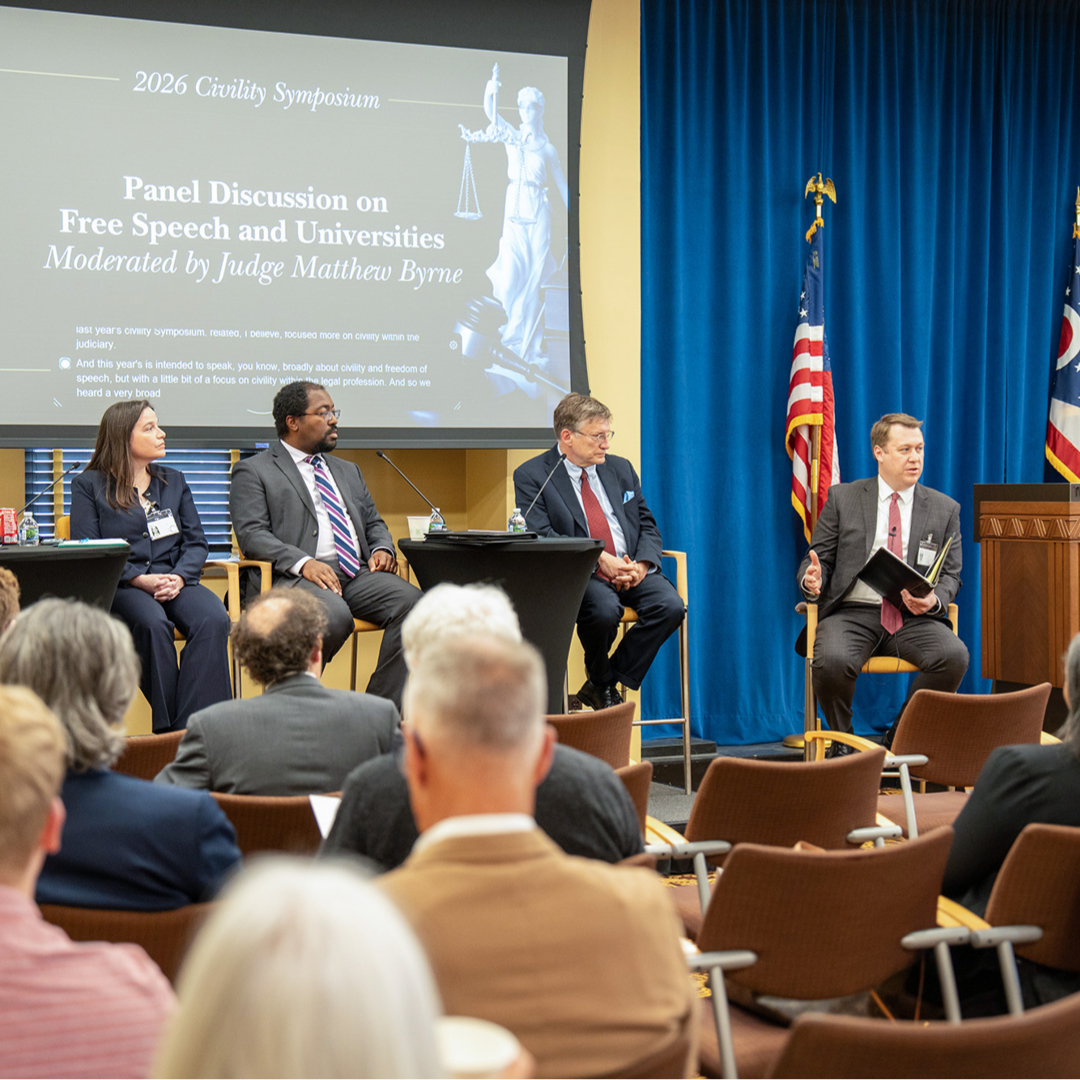
Judge Matthew Byrne leads a panel discussion during the Supreme Court of Ohio’s Civility Symposium.
Constitutional scholars, lawyers, and judges emphasized both the protection of free speech and the importance of civility in public discourse during the Supreme Court of Ohio’s Civility Symposium.
Both in person and online, Ohio legal professionals discussed the significance of free speech at the event, which took place at the Thomas J. Moyer Ohio Judicial Center. The symposium examined both the history of freedom of expression in the United States and the future of freedom of speech as the world enters a new era in which artificial intelligence becomes a dominant force in generating and disseminating ideas.
Chief Justice Sharon L. Kennedy kicked off the symposium, noting that discussing free speech in civil society is particularly timely as the nation celebrates the 250th anniversary of the Declaration of Independence.
“Has there been a more impactful assertion of free speech, before or since?” she said.
Chief Justice Kennedy said the signing of the declaration was a challenge to the authority of a king, and while it launched a revolution, its tone was “restrained and civil, appealing to reason, not emotion.”
“This symposium is born from similar notions that we must advance free speech in our country with the recognition that when coupled with civility, there is the breathing space needed to exchange thoughts, promote inquiry, and enhance civic engagement. Liberty starts with free speech and ends without it,” she said.
More than 1,500 legal professionals joined the event online, with more than 100 participants attending in person.
Renowned author and constitutional scholar Jonathan Turley opened the session by discussing the impact of “rage” in American politics, law, and society. He noted that the country has been through cycles in which rage has played a dominant role in shaping how people communicate, and that we are currently in a rage cycle. He added these cycles aren’t permanent and the country has historically returned to calmer, more civil discourse.
“Rage is here. It’s not burning off yet. We have a while to go until we realize what we’ve become, and we decide to change who we are. But it’s happened before,” he said.
Turley is a professor of public interest law at George Washington University and author. His latest book, “Rage and the Republic: The Unfinished Story of the American Revolution,” is a New York Times best-seller. He closed his presentation by expressing that human civilization has always persevered with “hope,” and he believes hope will help guide society through the profound changes brought on by AI and other technological advancements.
The symposium also included presentations by Ilya Shapiro, director of constitutional studies at the Manhattan Institute, who discussed concerns about protecting free speech on college and university campuses. Drawing in part on his experiences as a faculty member, Shapiro addressed how institutional pressures, campus culture, and administrative responses can affect the expression of viewpoints in academic settings, and he raised concerns about the implications for open inquiry and debate within higher education.
A panel discussion on free speech and universities followed. Twelfth District Court of Appeals Judge Matthew Byrne hosted the conversation with Ohio Solicitor General Mathura Sridharan, attorneys Julie Byrne and Phillip Williamson, and Capital University Law School Professor Bradley Smith.
Framing the discussion around First Amendment principles, the panel examined tensions between the rights of association, including an attorney’s discretion to decline representation, and efforts by others to restrict or discourage participation in certain cases based on viewpoint or affiliation. Panelists also addressed the responsibilities of attorneys as stewards of free speech, the loss of perspective that can accompany a decline in civility, and the role colleges and law schools play in fostering balanced discourse.