
From Ban to Boom: History of Fireworks Laws in Ohio
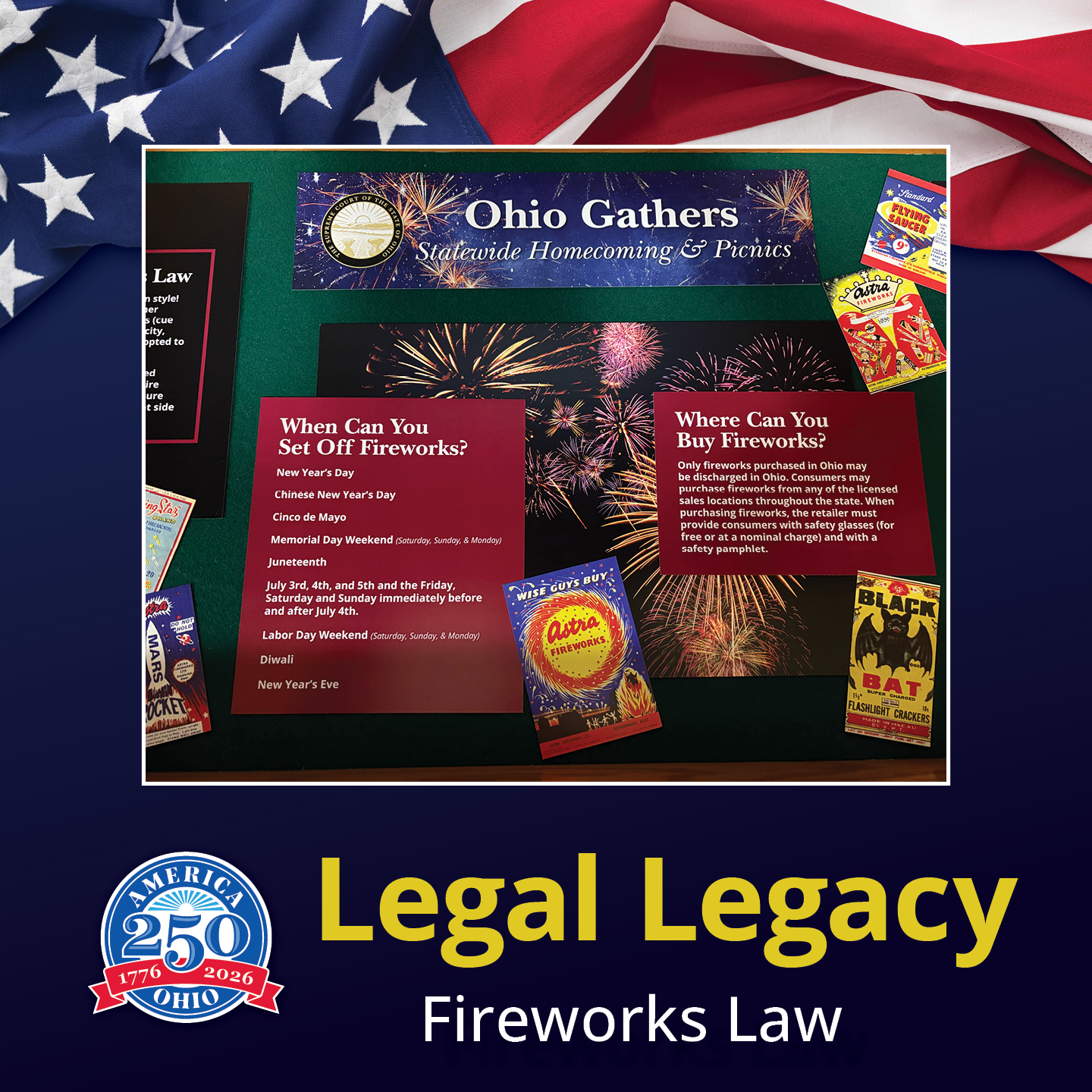
In July, a new Supreme Court display explores firework laws in Ohio.
From handheld sparklers to dazzling displays that light up the night sky, fireworks have long been a staple of Fourth of July celebrations.
While the colorful bursts captivate audiences, fireworks come with risks. Ohio laws have evolved over time to balance public enjoyment with safety. Those changes are highlighted in a display at the Supreme Court of Ohio as part of the yearlong America 250 celebration.
History of Ohio Legislation
The laws that currently allow Ohioans to purchase and use fireworks around Independence Day are relatively recent.
The Revised Code defines “fireworks” as “any composition or device prepared for the purpose of producing a visible or an audible effect by combustion, deflagration, or detonation.” The law provides specific exceptions for items such as household matches, distress signals, railroad operations, and pyrotechnic devices sold to the armed forces.
In the 1900s, Ohio law stated, “it shall be unlawful for any person to possess for sale at retail or to sell at retail or for any person to discharge, ignite or explode any fireworks.” This strictly prohibited public or private firework displays of any sort in the state unless written permission was obtained from a fire chief or sheriff.
However, in July 2022, new legislation was passed to permit the sale and use of fireworks while maintaining the safety of the user. According to state law, fireworks cannot be aimed at any person or object, discharged indoors, on public property, or if a weather hazard exists. The only fireworks allowed to be discharged in Ohio are those purchased in Ohio from a licensed location. And, as part of this legislation, any jurisdiction within the state can opt-out of the new permissions, giving counties and cities the ability to decide what is best for their area.
For people under the age of 18, it remains illegal to handle fireworks or be within 150 feet of the discharge of fireworks.
Fireworks by Design
The most widely recognized firework is referred to by the American Pyrotechnics Association as a peony. The peony’s rapid burst of color into a neat circle is a classic in displays. Other shapes, such as the umbrella-shaped brocade, chrysanthemum, crossette, pistil, and waterfall add variation to a fireworks show. Salutes create quick flashes and are commonly used in large quantities during the big finales. Pattern shells are used to create smiley faces, hearts, letters, and other recognizable shapes in the sky.
Fireworks are different colors due to different chemicals being added to their casing during production. Red, created with strontium, and green, created with barium, are quite common due to the brightness of the colors, according to the United States Geological Survey. Blue fireworks are made with copper and are not as easy to manipulate, while gold and yellow fireworks are created with elements to produce a shimmering effect as they decorate the dark sky.
See Fireworks Law Display in Person
Plan a visit to the Court to learn more about Ohio's fireworks laws by viewing the America 250 display in the Grand Concourse.
As America prepares for its 250th birthday on July 4, 2026, the Supreme Court is celebrating the semiquincentennial with a yearlong celebration called “The Story of America,” highlighting significant historical events. Beyond digital content, the celebration includes events and displays at the Court. The initiative aims to spark curiosity, enhance civic literacy, and honor key moments in American and Ohio history.