
Reflections on 2025
As the year winds down, it’s a chance to review the good work of the Supreme Court of Ohio, from its important legal decisions to its resourceful approaches to serve the courts, legal community, and public.

The past year at the Supreme Court rang in with welcomes for the most recently elected justices and portrait dedications honoring prior justices. In addition to the hundreds of cases the Court decided in 2025, it was a year lively with new projects, including exhibits for visitors, exciting activities connected to the America 250 celebration, and videos to enlighten viewers on the latest legal topics.
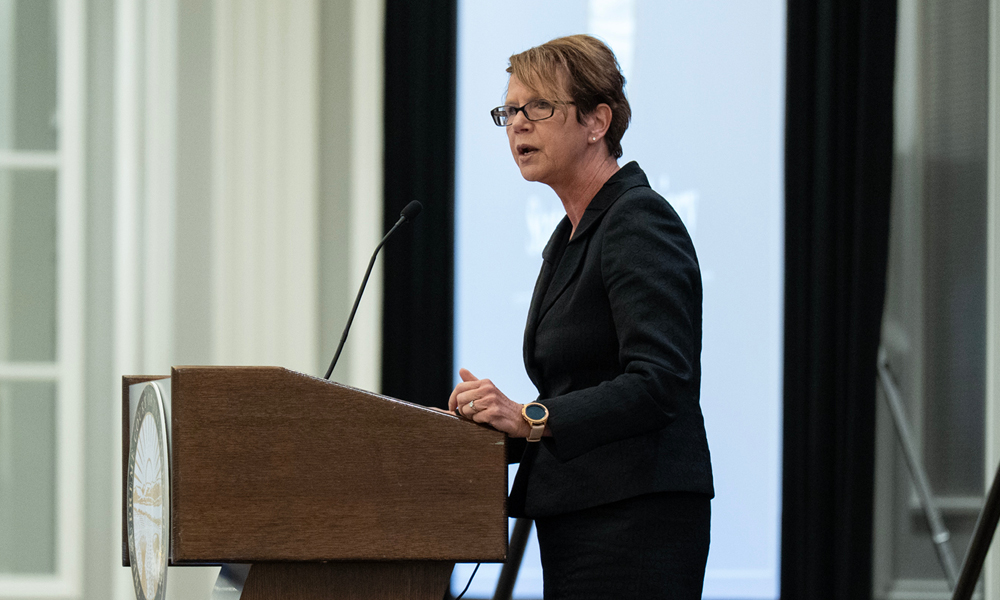
In her State of the Judiciary address in the fall, Chief Justice Sharon L. Kennedy emphasized the principle of judicial independence.
Chief Justice Applauds Ingenuity of Ohio Courts
Chief Justice Sharon L. Kennedy delivered a powerful and inspiring State of the Judiciary address to judges and judicial leaders from across the state. Chief Justice Kennedy emphasized the importance of judicial independence, timely justice, innovation, and community partnerships in shaping the future of Ohio’s courts.
She commended the Ohio judiciary’s commitment to exploring new ideas, highlighting the transformative impact of specialized dockets and community-driven initiatives. She also unveiled strategies to enhance access to justice, improve case timeliness, and support the next generation of legal professionals.
“Judicial independence is the cornerstone of our republic,” Chief Justice Kennedy said. “It is your independence and ingenuity that drive Ohio courts to meet the people where they are – through specialized dockets, community partnerships, and ensuring that all who enter our courthouses have a meaningful opportunity to be heard.”
Three Justices Welcomed at Formal Celebrations
Early in the year, formal ceremonies were held to honor three justices being sworn in to serve on the Supreme Court.
Justice Joseph T. Deters returned to the bench in a new seat this year as the 163rd justice. He was elected to a full six-year term in November 2024. Among the numerous professional accomplishments mentioned at his January investiture ceremony, Justice Deters was Hamilton County’s longest-tenured prosecutor, holding that position from 1992–1999, and again from 2005–2023. Justice Deters was appointed to a vacant seat on the Court with a term that began in January 2023.
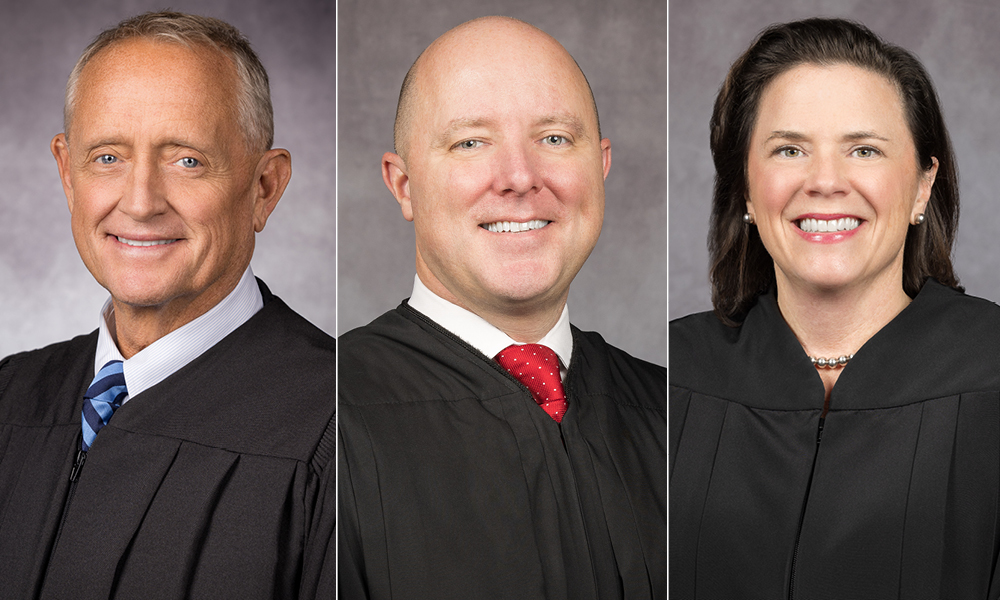
Justices (from left) Joseph T. Deters, Daniel R. Hawkins, and Megan E. Shanahan.
“His service on the Court over the past two years is marked by thoughtful deliberation on legal issues that have come before the Court, and the collegial way and manner in which he shares his view with all of us on the law,” said Chief Justice Kennedy.
Justice Daniel R. Hawkins was welcomed as a new justice at a February investiture ceremony. Prior to joining the Court as its 164th justice, Justice Hawkins served as a judge on the Franklin County Common Pleas Court. He began his legal career at the Franklin County Prosecutor’s Office, where he spent 13 years as a trial prosecutor, 10 of those as director of the office’s Special Victims Unit. He also served as a judge in the environmental division of the Franklin County Municipal Court.
At the ceremony, a former colleague and mentor from the prosecutor’s office described Justice Hawkins as having a sense of ease with victims and being inherently compassionate. As a judge, Justice Hawkins was fair and just and respected for both his rulings and the way he treated everyone with dignity, the colleague said.
Justice Megan E. Shanahan was honored at a March investiture by speakers who shared the justice’s accomplishments and her path to the Supreme Court. Prior to becoming the Court’s 165th justice, she spent more than a dozen years as a judge on both the Hamilton County Municipal Court and Hamilton County Common Pleas Court. Before her judicial career, Justice Shanahan distinguished herself as a felony-level criminal prosecutor in both Butler and Hamilton counties.
A longtime friend who spoke at the ceremony said Justice Shanahan won’t give up when she sets out to do something.
“When there’s a difficult decision to be made, she’ll make it. Her heart won’t even tick up a bit,” her friend said. “Of course, she’s smart, well prepared, and dedicated to doing the right thing. Can you think of better qualities for a Supreme Court justice?”
Court Rules on Cellphone Searches, Crime Victim Rights, and Judicial Free Speech
Task Force Releases Report on Juvenile Diversion
In June, a Supreme Court Task Force on Juvenile Diversion released its report on local court practices for diverting juveniles away from the juvenile justice system to address root causes of delinquent behavior. Diversion is an informal alternative where juveniles are held accountable for their behavior but referred to services to deal with difficulties, such as food and housing insecurity, joblessness, inadequate educational resources, and unmet mental health needs. The task force, formed by Chief Justice Kennedy and chaired by Judge David A. Hejmanowski of the Delaware County Juvenile/Probate Court, offered 10 recommendations. Among them, the task force suggested that courts formalize their practices when redirecting juveniles to intervention services before an initial court appearance and ensure compliance with victim rights laws.
The 21-member task force was comprised of juvenile justice system stakeholders, judges, law enforcement officers, prosecutors, public defenders, legislators, law school professors, and juvenile justice experts.
Committee Appointed To Review Law School Accreditation Process
The Supreme Court formed an advisory committee in June to evaluate and review the accreditation process for Ohio’s law schools. In its review of current accreditation standards and procedures, the committee will place an emphasis on identifying potential opportunities for innovation, in light of the evolving needs of the legal profession. Chief Justice Kennedy established the committee as part of the Court’s ongoing efforts to ensure excellence and innovation in the state’s legal education processes. Robert W. Horner III, the Court’s administrative director, is chairing the committee.
Portrait Dedications Spotlight Service of Past Justice and Chief Justice
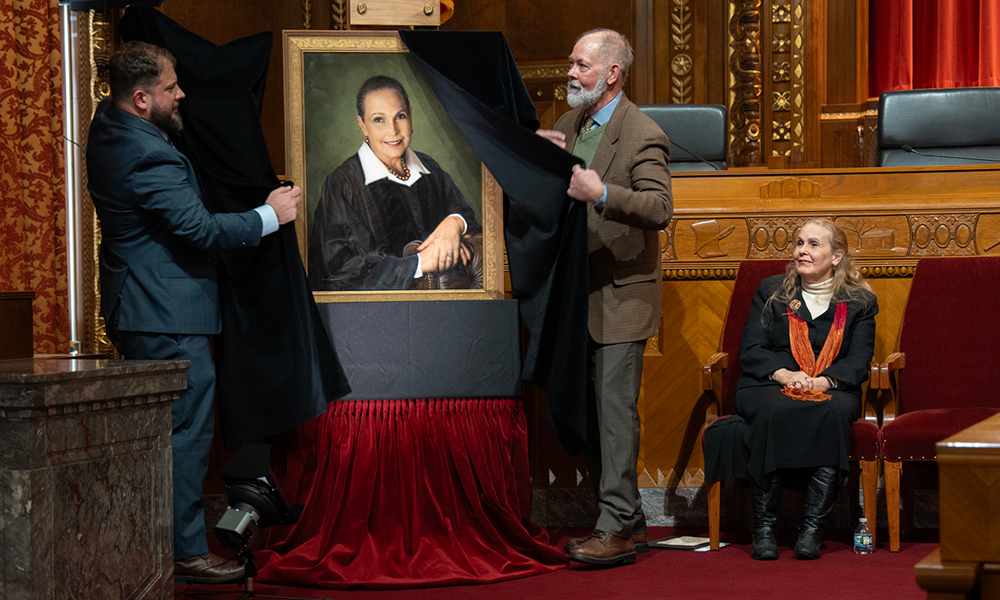
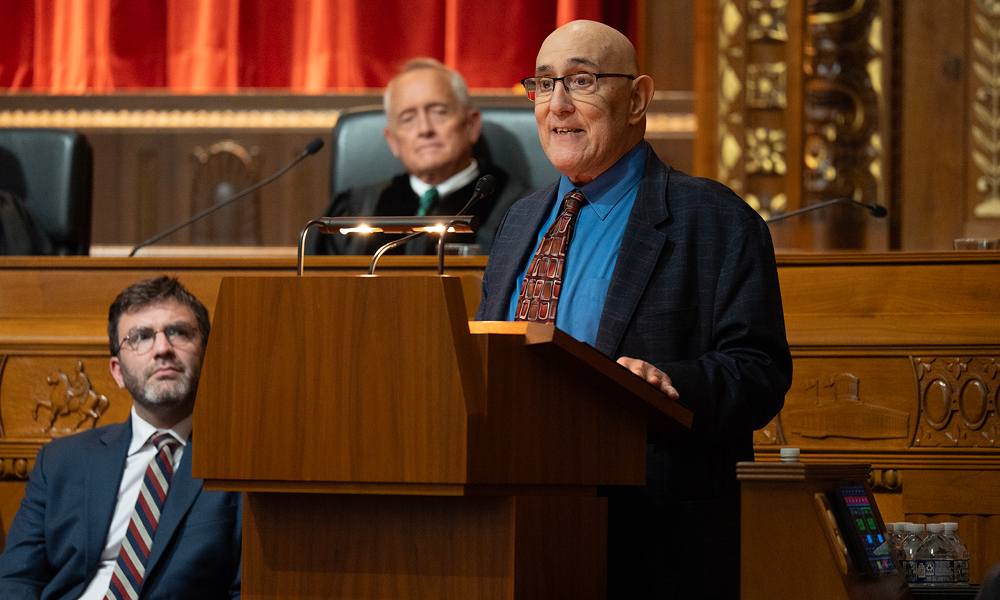
The Supreme Court accepted portraits of retired Justice Evelyn Lundberg Stratton (top photo) and former Chief Justice Eric S. Brown (bottom photo) at events in their honor.
A reminder of the lasting impact that retired Justice Evelyn Lundberg Stratton made on courts in Ohio and nationwide will now permanently hang on the walls of the Thomas J. Moyer Ohio Judicial Center.
Justice Stratton served on the Supreme Court from 1996 until her retirement at the end of 2012.
Her compassion for people shined through in her work at the Court and beyond. She led the way for adoption reform, shaped specialized dockets for veterans and for individuals with mental health issues, and advocated for the visually impaired.
When presented with the opportunity to have a portrait dedicated to her life’s work, Justice Stratton was at first resistant, but her family impressed on her that there was a greater meaning behind the ceremony. Her youngest son, Tyler, explained that the portrait is a reminder to everyone who passes it to do what is right in the world, not what it is easy.
“She did this for decades, not for political agendas, for good press, or to get reelected, but because it was right, and she had the power to do it and help,” her son said.
Former Chief Justice Eric S. Brown was honored in February during a ceremony at the Court to unveil and accept his portrait. After the unexpected death of Chief Justice Thomas J. Moyer in 2010, then Gov. Ted Strickland needed to appoint a replacement. The governor turned to Franklin County Probate Court Judge Brown, knowing his background in public service and political courage.
“I knew that Eric’s character and demeanor were ideal for leading Ohio’s courts and the legal profession. I admired his dedication to public education and the various issues that were likely to come before this Court,” Strickland said.
Brown served nine months as chief justice and went on to serve the public in other roles.
Reports Tout Judicial Assignment Program, Compile Case Statistics
In the spring, an annual report on the Judicial Assignment Program was released. The report highlighted the innovations, improvements, and accountability achieved in 2024. Accomplishments included a decreased amount of time needed to process requests for assigned judges and continued savings for Ohio taxpayers, with the lowest compensation paid to judges since 2020. The Judicial Assignment Program advances the timely administration of justice and resolution of cases by ensuring the availability of a judge when an elected or appointed judge is unavailable to hear a case.
The Court also released the 2024 Case Statistics Annual Report. The report noted that the Clerk’s Office accepted filings of more than 11,000 distinct documents, including 1,803 new cases. More than 1,700 cases were disposed of that year, with a case clearance rate of 95%. The report also detailed ongoing improvements in shortening the time between when a case is fully briefed and the date it is argued before the Court.
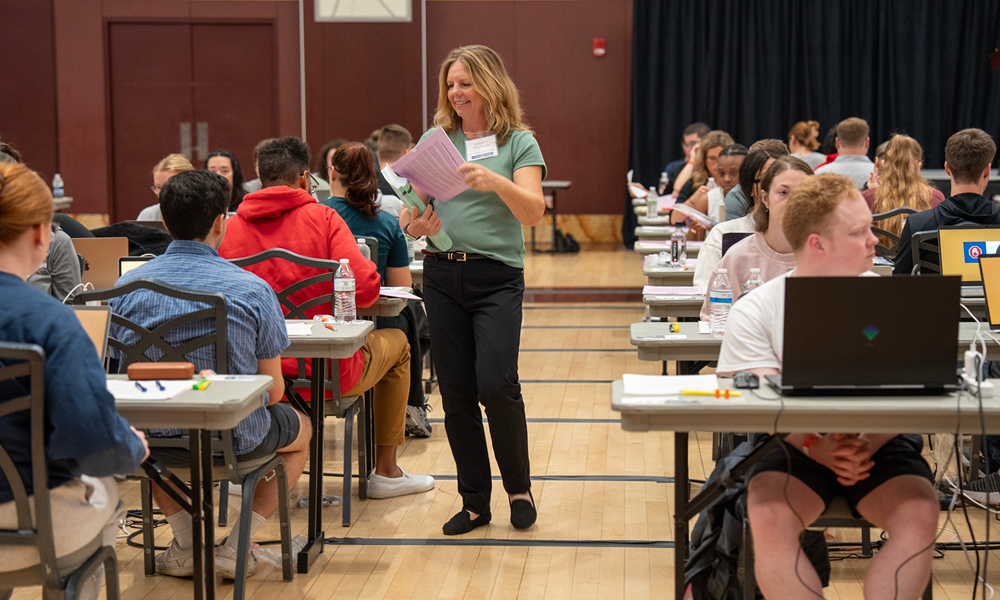
To better serve test-takers across the state, the Ohio bar exam is now being held in three locations.
Court Expands Locations for Taking Bar Exam
Under the Ohio Constitution, the Supreme Court regulates the admission to the practice of law in the state, and that includes administering the Ohio Bar Examination, given in February and July. To increase access and reduce travel burdens for those taking the exam, the Court in July began holding the bar exam in three locations spread out across the state: University of Cincinnati College of Law; Ohio State University; and Cleveland State University College of Law. Test-takers who passed the exam and met all other requirements were sworn in as attorneys at special sessions of the Supreme Court in May and November.
Reentry Challenges Underscored in Video Series
With thousands of individuals returning to Ohio communities annually after incarceration, the need for effective reentry programs and public awareness has never been more important. The Supreme Court introduced a series of videos in April aimed at fostering understanding, reducing stigma, and presenting actionable solutions. Each video is thoughtfully designed to reach key audiences and support the recommendations of the Court’s Reentry Task Force Report. The videos are tools for education, inspiration, and action, aligning with the broader goals of reducing recidivism and improving outcomes after incarceration.
The video above – “Encouraging Judicial Leadership with Reentry Dockets” – shines a light on the benefits of specialized court dockets focused on reentry by presenting compelling narratives, expert commentary, and examples of judicial leadership. The other videos are:
- A 30-Second Public Service Announcement to Reduce Stigma.
- A Message of Hope for the Reentry Population.
Additional Videos Feature Cases Before Court and Select Decisions
The Supreme Court also debuted two video series this year about its cases. The videos offer another avenue for the public to understand the work of the state’s court of last resort. In “Making the Case,” viewers enjoy a front-row seat at the Court’s oral arguments, where the state’s most complex legal questions are debated. Through “Featured Decision,” certain Court rulings are explained in an engaging format. Watch “Making the Case” and “Featured Decision” on the Supreme Court YouTube channel.
In another video released this year, the Court invites the public to see history in the making by attending oral arguments. The video includes tips for visiting the Moyer Judicial Center.
AI Insights for Legal Community Gathered in Online Library
The rapidly evolving technologies of artificial intelligence and generative artificial intelligence are already impacting courts and the legal system – from how judges and magistrates write opinions, to the briefs and motions prepared by attorneys, to the evidence provided by parties in court. To assist, an “Artificial Intelligence Resource Library” was made available on the Supreme Court website, with information on:
- AI ethics guidelines for judicial officers and attorneys.
- AI practices in state courts.
- Legal association reports and statements.
- Journal and scholarly articles.
- Useful courses on the topic.

Nearly 800 attendees at the Supreme Court Specialized Dockets Conference enhanced their knowledge on reentry, trauma-informed practices, addiction science, ethics, and media relations.
Conference Delves Into Specialized Dockets
Nearly 800 judges, magistrates, probation officers, treatment providers, attorneys, and community partners attended the Supreme Court’s annual Specialized Dockets Conference in October. One conference highlight was the reentry simulations, which were coordinated by the Ohio Department of Rehabilitation and Correction. Participants in the simulation were given fictional identities as individuals just released from prison. Each person had varying amounts of money and access to resources, such as transportation. Yet all were expected to find jobs, secure housing, and attend appointments to meet parole requirements. Participants were faced with difficult decisions and no guidance to reach their goals. The simulations gave attendees a glimpse of the challenges incarcerated people face when released from prison, making courts more aware of the assistance needed for success.
The event drew 475 attendees in person in Columbus and another 300 online. Other sessions featured discussions on trauma-informed practices, addiction science, ethics, media relations, and more.
Event Explores Services for Veterans in Justice System
This year marked the 11th anniversary of the Lean Forward Veterans Summit. Chief Justice Kennedy convenes the summit annually as part of the broader Lean Forward initiative that seeks to advance treatment for justice-involved veterans in Ohio. The November Veterans Summit focused on veterans specialized dockets and supportive services. The summit explored emerging trends, innovative pathways to healing, civil legal services, and other programs for assistance. The summit was open to court staff, treatment providers, and other community stakeholders working with veterans.
In the healing pathways session, a leader from Save a Warrior described the transformative approaches they use to help veterans, active-duty servicemembers, and first responders who are having suicidal thoughts. The value of bonding with animals was also discussed, with speakers from Veteran Companion Animal Services (VCAS), which pairs veterans with dogs that are rescued and in need of homes, and Fieldstone Farm, a therapeutic equine center.
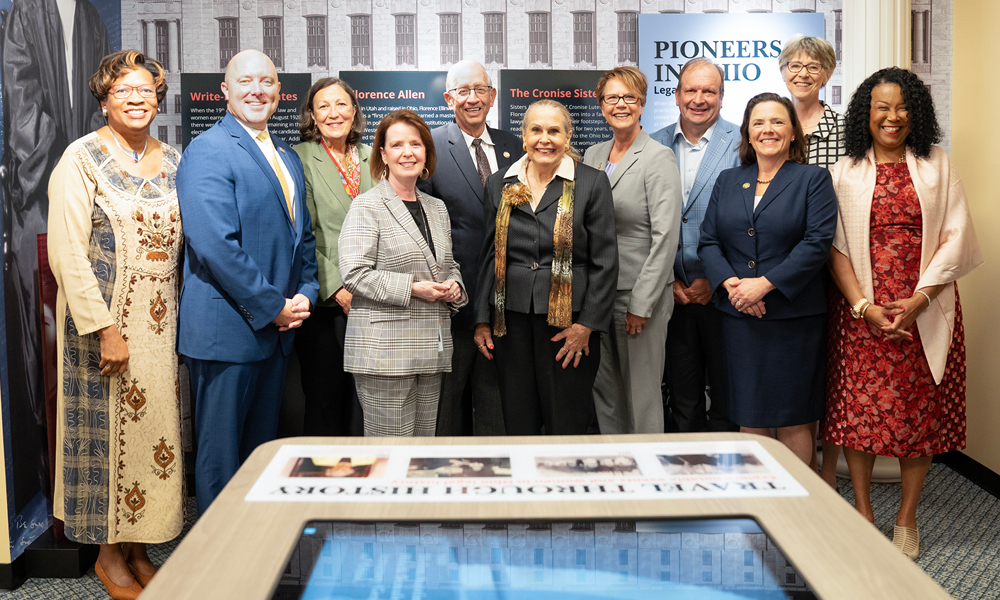
Current and former Supreme Court justices joined the opening of the Women in Law exhibit at the Moyer Judicial Center.
New Exhibits Celebrate Women in Law, Pivotal Historic Documents
The Supreme Court proudly unveiled its new “Women in Law” exhibit in August, a tribute to the extraordinary women who have shaped Ohio’s legal history and inspired future generations of lawyers. The exhibit, located in the Visitor Education Center of the Thomas J. Moyer Ohio Judicial Center, highlights the impact trailblazing women have made on Ohio’s legal system. The exhibit honors the women who broke barriers, challenged conventions, and redefined what is possible — not just for themselves, but for all who follow in their footsteps. Along with current justices, several former justices attended, including Evelyn Lundberg Stratton, Yvette McGee Brown, Judith L. French, Mary DeGenaro, and Melody J. Stewart.
As part of “America 250,” a yearlong celebration leading up to the 250th birthday of the United States in 2026, the Court opened another new exhibit in 2025 called “Ohio’s Foundational Documents.” The exhibit showcases the Declaration of Independence; the Articles of Confederation; the U.S. Constitution; the Northwest Ordinance; and the Ohio Constitution. Each played a critical role in Ohio’s journey from frontier territory to a thriving state. Visitors to the exhibit will gain a deeper understanding of how Ohio’s story intertwines with the broader American narrative, reflecting shared ideals of freedom, equality, and governance.
Also placed on display in May in the Court’s Law Library is the Melhorn exhibit, “Preserving Ohio’s Judicial Legacy.” The materials, donated by Frank Melhorn, center on an article titled, “Important Law Intelligence.” First published in the Scioto Gazette on Dec. 25, 1806 and attributed to Judge Calvin Pease, the article captures a significant contribution to the state’s legal history. Judge Pease, while facing considerable political pressure and the threat of impeachment, rendered a groundbreaking decision that ruled an act of the Ohio Legislature unconstitutional. This assertion of judicial independence marked the first recorded use of judicial review in Ohio and laid the foundation for the judiciary’s role as a coequal branch of government.
Special Events Bring Court to Students and Reveal Stories of Tuskegee Airmen
The Supreme Court is committed to educating the next generation about the judicial branch and its crucial role for the people of this country. To support that mission, the justices hold oral arguments in Ohio communities as part of the Off-Site Court Program. High school students get to hear attorneys argue real cases before the justices in a county close to home as part of this traveling civic education event.
In April, Monroe County hosted its first Off-Site Court visit. More than 350 students attended the official Court session where justices considered arguments in three cases. In October, the Court heard another three cases in Defiance County, where a record-setting crowd of 1,836 students from five high schools in the county attended. It was also the first Off-Site Court held in Defiance. The Ohio Justice Bus, a mobile legal clinic, attended the event with staff to explain its services, particularly for areas of Ohio where there are attorney shortages. Students had the chance to tour the bus.
Another special event for students was held in February at the Court’s home at the Thomas J. Moyer Ohio Judicial Center. “Celebrating Excellence, Building Futures” was the theme for this year’s Black History Month gathering. It honored the Tuskegee Airmen, their connection to Ohio, and the contributions of Black Ohioans and their legacy of inspiring careers in law. The speakers described the many life lessons that students can learn from the Tuskegee Airmen, who were the first all African American unit in the Army Air Forces.

The Judicial College at the Supreme Court offers hundreds of courses every year specifically designed for Ohio’s judges, magistrates, and court personnel.
Courses Keep Judicial Branch Informed
Developing courses for judges, magistrates, and court personnel to learn the basics and explore emerging court trends is at the heart of the Ohio Judicial College’s mission for the Ohio legal community each year. The courses also address challenges encountered in state courts and give attendees a chance to share ideas and best practices. In 2025, courses designed by the college for judicial leaders and court staff numbered 400 – more than one for every day of the year.
One of the all-time favorites is called “Crime and Punishment.” Attendees visit the historic Ohio State Reformatory, the setting for the film “The Shawshank Redemption,” and the Mansfield Correctional Institution, an active prison. Thirty-seven judges attended this year’s course to gain an understanding of the intersection between courts and corrections by exploring both the history of the state’s corrections system and the daily routines of those who are incarcerated today.
Resources Continue To Be Developed for Courts
A comprehensive collection of bench cards, guides, and toolkits – called “Resources for the Bench” – was assembled this year to better assist judges, lawyers, and the public in navigating Ohio’s legal system. As part of the invaluable resources, important Ohio statutes and court decisions are summarized to support courtroom decision-making and enhance understanding of the law. The collection features an expansive range of topics relevant to Ohio courts, including remote hearings, sentencing guidelines, domestic violence protections, and procedural fairness for self-represented litigants.
Providing guidance to assist local courts and attorneys is a key activity at the Court. Among the materials developed in 2025:
- A Supreme Court toolkit on intervention in lieu of conviction, an arrangement where eligible defendants admit guilt but have their criminal proceedings put on hold while they complete a recommended intervention plan.
- A webpage about certificates of qualification for employment, compiling available resources for individuals seeking relief from employment restrictions due to past criminal charges.

“The Story of America” is the Supreme Court’s yearlong celebration leading up to America’s 250th birthday in July 2026.
Court Launches America 250 Initiative
The Court is commemorating the U.S.’s upcoming 250th birthday on July 4, 2026, through a yearlong America 250 celebration titled, “The Story of America.” This initiative highlights the nation’s journey over the past 250 years, with a special focus on the role of the judiciary, the U.S. Constitution, and Ohio’s unique contributions to American history. The America 250 initiative is designed to spark curiosity, enhance civic literacy, and honor the key moments that have shaped both the nation and the state of Ohio. Through a combination of digital content, educational programs, and in-person events, the Court aims to engage the public, educators, and the legal community in celebrating this momentous occasion.
CREDITS:
Design: Ely Margolis
Web: Erika Lemke